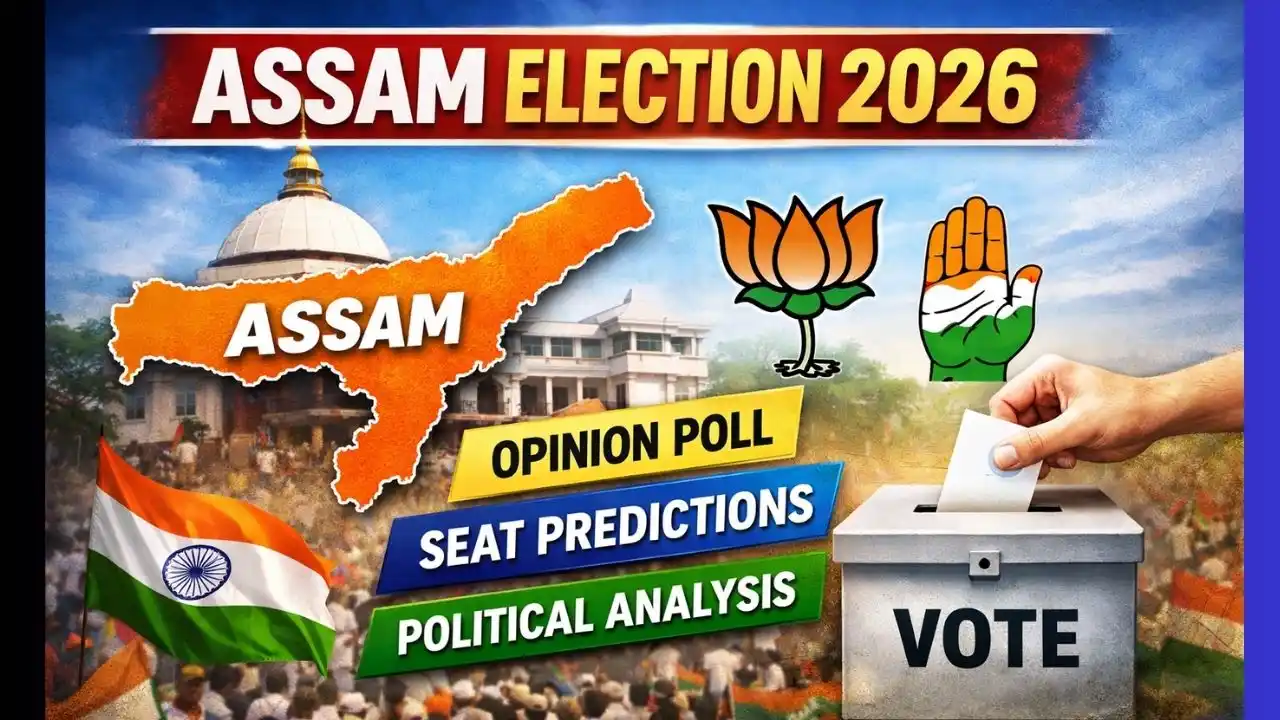
The Assam Assembly Election 2026 is expected to be one of the most closely watched political contests in Northeast India. The outcome of this election will determine who governs the state for the next five years and will significantly influence the region’s political direction.
Assam has a 126-member Legislative Assembly, and any political party or alliance must win at least 64 seats to form the government. As the election approaches, political campaigns are intensifying, alliances are evolving, and various opinion polls and survey reports have started estimating voter sentiment.
Opinion polls are not final results, but they offer useful insights into how voters currently feel about different political parties, leadership, and government performance. These surveys also reflect how key issues like development, employment, and regional identity are shaping the political narrative.
This article provides a detailed analysis of the Assam Election 2026 opinion poll, seat predictions, political strategies of major parties, voter issues, and possible election outcomes.

Assam Assembly Election 2026
The next Assam Legislative Assembly election is expected to be held around March–April 2026, as the current assembly’s term ends in May 2026. All 126 constituencies across the state will participate in the voting process.
The present government is led by Chief Minister Himanta Biswa Sarma of the Bharatiya Janata Party. The party governs Assam as part of the National Democratic Alliance (NDA), which includes regional partners.
In the 2021 Assam Legislative Assembly election, the BJP-led NDA successfully retained power. The alliance secured 75 seats out of 126, comfortably crossing the majority mark. The main opposition force was the Indian National Congress, which contested the election as part of a broader opposition alliance.
Since the last election, Assam has witnessed several political and administrative developments, including infrastructure projects, welfare schemes, and policy initiatives. These developments are expected to play a major role in shaping voter opinions in the upcoming election.
Assam’s political environment is unique because it combines national party influence with strong regional political dynamics. Apart from the BJP and Congress, several regional parties represent specific ethnic groups and communities, making electoral contests complex and unpredictable.
Several key factors traditionally influence elections in Assam, including:
- Infrastructure and development projects
- Flood management and disaster response
- Employment and economic growth
- Welfare programs for tea garden workers
- Citizenship and migration policies
- Ethnic identity and regional representation
Because these issues affect different communities in different ways, political parties design targeted campaigns to appeal to specific voter groups.
As the election timeline approaches, political observers expect intense campaigning, alliance negotiations, and new survey results that could change the electoral narrative.
Assam Assembly Election Details
| Key Topic | Important Information |
|---|---|
| Election Name | Assam Assembly Election 2026 |
| Total Assembly Seats | 126 seats in the Assam Legislative Assembly |
| Majority Mark | 64 seats required to form the government |
| Expected Election Time | March – April 2026 |
| Current Chief Minister | Himanta Biswa Sarma |
| Ruling Party | Bharatiya Janata Party led NDA alliance |
| Main Opposition Party | Indian National Congress |
| Previous Election Result (2021) | NDA won 75 seats and formed the government |
| Estimated NDA Seats (Opinion Poll) | 70 – 90 seats |
| Estimated Congress Alliance Seats | 30 – 45 seats |
| Other / Regional Parties | 5 – 10 seats |
| Key Regional Parties | Asom Gana Parishad, Bodoland People’s Front, United People’s Party Liberal |
| Major Voter Issues | Flood management, employment, development, tea garden worker welfare |
| Total Voters in Assam | Around 2.5 crore registered voters |
| Possible Outcome | NDA advantage but election could still become competitive |
Assam Election 2026 Opinion Poll: Latest Survey Trends
Early opinion polls conducted by political analysts and survey organizations suggest that the NDA alliance currently holds an advantage in the state. While the election is still months away, early voter sentiment appears to favor the ruling coalition.
According to several pre-election survey discussions and political analysis reports, the BJP-led alliance continues to enjoy support in many constituencies due to leadership popularity, development initiatives, and a strong organizational structure.
However, these surveys also indicate that the opposition is actively trying to rebuild its political base and could improve its performance if alliances are strengthened before the election.
Estimated Seat Projection (Based on Survey Trends)
| Alliance / Party | Expected Seat Range |
|---|---|
| NDA (BJP + allies) | 70 – 90 |
| Congress and allies | 30 – 45 |
| Regional parties / Others | 5 – 10 |
These numbers are not official results. Opinion polls simply represent a snapshot of voter mood at a particular moment. Political developments, candidate selection, and campaign momentum can significantly change the final outcome.
Political experts often emphasize that Assam elections can produce unexpected results because regional alliances and constituency-level dynamics play a major role.
Another key factor influencing opinion polls is the perception of government performance. Many voters evaluate the ruling government based on visible development work, infrastructure expansion, and welfare schemes.
At the same time, opposition parties try to highlight governance challenges such as unemployment, price rise, and regional concerns to shift voter sentiment.
As more surveys are conducted closer to the election date, the seat projections may change significantly. For now, early trends suggest that the contest may revolve around whether the ruling alliance can retain its dominance or whether the opposition can build a stronger coalition.
NDA Alliance Strategy and Strengths
The NDA alliance, led by the BJP, is entering the 2026 election with strong political confidence. Party leaders believe that their governance record and organizational strength provide a solid foundation for another electoral victory.
Chief Minister Himanta Biswa Sarma has repeatedly expressed confidence that the alliance remains strong in many constituencies. According to political discussions within the party, the leadership may also introduce several new candidates to bring fresh energy to the campaign.
1. Leadership Influence
One of the biggest strengths of the ruling alliance is the popularity of Himanta Biswa Sarma. He is widely regarded as one of the most influential political leaders in Northeast India.
His leadership style, quick decision-making, and strong communication strategy have helped the BJP expand its support base in Assam.
2. Focus on Development
The NDA government frequently highlights its development work. Major initiatives include:
- Expansion of road networks
- Construction of bridges and highways
- Investment in healthcare infrastructure
- Educational reforms and new institutions
These development projects are often showcased during political rallies and campaigns to convince voters that the government has delivered tangible results.
3. Alliance with Regional Parties
Political alliances are critical in Assam elections. The BJP has partnered with several regional parties to strengthen its presence in areas dominated by ethnic communities.
For example, regional parties like Asom Gana Parishad and United People’s Party Liberal have supported the NDA alliance in previous elections.
Such alliances help expand the coalition’s influence in regions where national parties alone might struggle.
4. Strong Booth-Level Organization
Another major advantage for the BJP is its extensive grassroots network. Over the past decade, the party has built a strong booth-level organization that helps mobilize voters effectively during elections.
Local party workers play a crucial role in reaching voters, organizing campaign events, and ensuring voter turnout.
Because of these factors, political analysts believe the NDA may enter the election as the front-runner, although the final outcome will depend on campaign dynamics and opposition strategies.
Congress Strategy and Opposition Politics
The Indian National Congress remains the primary opposition party in Assam and is preparing an aggressive strategy to challenge the ruling alliance in the 2026 election.
After losing power in previous elections, the party has been working to rebuild its organizational strength, reconnect with voters, and form alliances with regional parties.
One notable step taken by Congress has been the early announcement of several candidates even before the official election schedule. This move indicates the party’s intention to begin campaigning well in advance.
1. Leadership Projection
Congress has been promoting younger leaders as part of its long-term political strategy. One prominent figure is Gaurav Gogoi, who has emerged as a key voice for the party in Assam politics.
Projecting new leadership is intended to appeal to younger voters and present the party as a modern political alternative.
2. Alliance Building
Opposition unity could play a major role in determining the election outcome. Congress is exploring partnerships with regional parties to consolidate anti-BJP votes.
If multiple opposition parties contest separately, the vote share could split, benefiting the ruling alliance.
3. Focus on Local Issues
Congress is attempting to shift the campaign narrative toward issues such as:
- Rising unemployment
- Economic challenges
- Inflation and cost of living
- Governance concerns
By highlighting these issues, the party hopes to build momentum among voters dissatisfied with the current administration.
4. Targeting Anti-Incumbency
In many elections, opposition parties try to capitalize on anti-incumbency sentiment, which occurs when voters seek change after a government has been in power for a long period.
Congress strategists believe that if they successfully highlight governance gaps, they may be able to reduce the ruling alliance’s advantage.
However, analysts often point out that the opposition’s biggest challenge will be maintaining unity among different regional partners.
Role of Regional Parties in Assam Elections
Regional political parties play a very important role in Assam’s electoral politics. These parties often represent specific ethnic communities or regional interests and can influence the outcome in several constituencies.
Some important regional parties in Assam include:
- Asom Gana Parishad
- Bodoland People’s Front
- United People’s Party Liberal
- Raijor Dal
In many constituencies, the support of regional parties can decide whether a candidate wins or loses.
For example, the Bodoland region has several assembly seats where regional parties enjoy strong influence. Alliances involving these parties can significantly change the electoral outcome.
Regional parties also bring attention to local issues that national parties sometimes overlook. These issues may include tribal rights, land protection, cultural identity, and regional development.
Because of this influence, political alliances before elections often focus heavily on negotiating seat-sharing agreements with regional parties.
Key Issues Influencing Voters in Assam
Every election is shaped by the concerns and expectations of voters. In the case of Assam, several issues are likely to influence the 2026 election.
Flood Management and Infrastructure
Flooding remains one of the most serious challenges in Assam. Many districts face annual flooding during the monsoon season.
Voters often judge governments based on how effectively they manage flood control, river embankments, and disaster relief operations.
Employment Opportunities
Youth unemployment is a major concern across the state. Many young voters expect political parties to provide clear plans for job creation and economic growth.
Employment policies, skill development programs, and industrial investment are frequently discussed during election campaigns.
Tea Garden Workers’ Welfare
Assam has one of the largest tea industries in the world. Millions of workers depend on tea gardens for their livelihood.
Issues such as wages, healthcare facilities, housing, and social welfare programs for tea garden workers are central to political debates.
Migration and Identity Politics
Questions related to citizenship, migration, and regional identity have historically influenced Assam politics.
Policies related to border management and citizenship laws often become major campaign topics.
Development vs Governance Debate
The election could also become a debate between two narratives:
- The ruling alliance highlighting development achievements
- The opposition focusing on governance shortcomings
How voters respond to these competing narratives will significantly influence the final result.
Voter Demographics and Electoral Landscape
Assam has a large and diverse voter population. According to recent electoral data, the state has around 2.5 crore registered voters across its 126 constituencies.
The electorate includes a wide variety of communities:
- Urban and rural populations
- Youth voters
- Tea garden workers
- Tribal communities
- Minority groups
Political parties design different campaign strategies to appeal to these groups.
For example:
- Youth voters prioritize jobs and education
- Rural voters focus on agriculture and infrastructure
- Minority communities consider representation and security issues
Because of this diversity, election results often vary significantly across regions.
Understanding the demographics of each constituency is crucial for political parties when selecting candidates and planning campaigns.
Possible Political Scenarios for Assam Election 2026
Based on current political trends and early opinion polls, several possible outcomes could emerge in the 2026 Assam election.
Scenario 1: NDA Retains Power
If the ruling alliance maintains its current popularity and organizational strength, it could win another term with a comfortable majority.
Scenario 2: Competitive Election
If the opposition manages to form a strong coalition and successfully mobilize anti-incumbency sentiment, the election could become highly competitive.
Scenario 3: Hung Assembly
Although less likely, a fragmented vote share among multiple parties could result in a hung assembly, where no party crosses the majority mark.
In such a scenario, post-election alliances would determine who forms the government.
Assam Assembly Election F.A.Q.
– When will the Assam Assembly Election 2026 be held?
The Assam Assembly Election 2026 is expected to take place around March to April 2026. The current legislative assembly term will end in May 2026, so the Election Commission will schedule voting before that deadline. The official election dates, nomination period, and voting phases will be announced closer to the election.
– How many seats are there in the Assam Legislative Assembly?
The Assam Legislative Assembly has a total of 126 seats. To form the government, a political party or alliance must win at least 64 seats, which is the majority mark required to control the assembly.
– What do the latest Assam Election 2026 opinion polls suggest?
Recent opinion polls and political surveys indicate that the ruling NDA alliance currently has an advantage in the upcoming election. Several survey projections suggest the NDA could win between 70 and 90 seats, while the Congress and its allies may secure around 30 to 45 seats. However, these numbers are only estimates and can change as the election approaches.
– Which political parties are the main contenders in the Assam Election 2026?
The primary political contest is expected to be between the ruling Bharatiya Janata Party led NDA alliance and the opposition Indian National Congress. Apart from these national parties, several regional parties such as Asom Gana Parishad and United People’s Party Liberal may also play important roles in determining the final outcome.
– What are the key issues that may influence the Assam Election 2026?
Several major issues are expected to influence voter decisions in the 2026 election. These include flood management, infrastructure development, employment opportunities for youth, welfare of tea garden workers, and policies related to migration and regional identity. Political parties will likely focus their campaigns on these topics to attract voters.
Conclusion
The Assam Election 2026 is shaping up to be a crucial political contest between the ruling BJP-led NDA and the opposition Congress along with regional parties.
Early opinion polls suggest that the NDA currently enjoys an advantage, largely due to leadership popularity, development initiatives, and a strong organizational network. However, elections can change quickly, especially if opposition alliances strengthen or new political issues emerge.
Regional parties, voter demographics, and key issues such as employment, flood management, and economic development will all play a decisive role in shaping the final result.
It is important to remember that opinion polls are only indicators of current voter sentiment. The final outcome will depend on campaign performance, candidate selection, and voter turnout.
As the election date approaches, new surveys and political developments will provide clearer insights into which party is most likely to form the next government in Assam.
Also read:-
AG is a content writer and researcher at Assam Guwahati, focusing on government schemes, Assam-related updates, education, finance, and public welfare programs. Through assamguwahati.com, he publishes informative articles, guides, and scheme updates to help readers understand benefits, eligibility requirements, and application procedures.