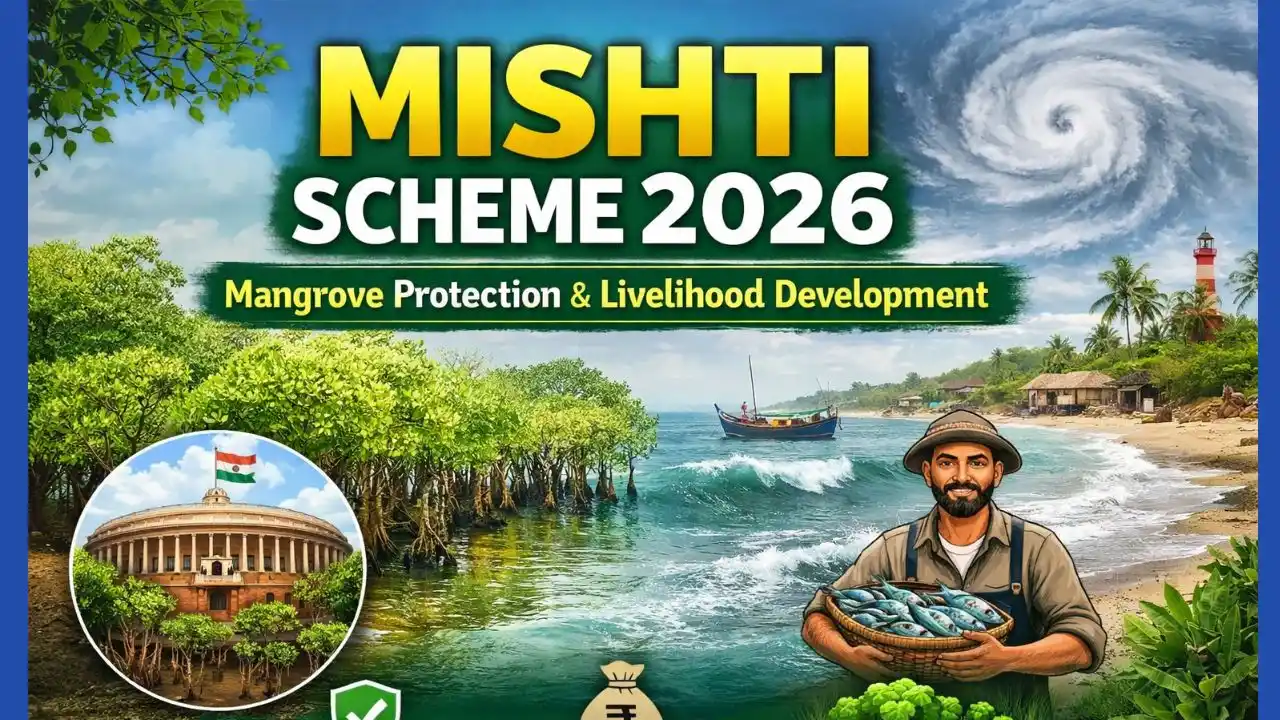
India’s coastline is both a strength and a vulnerability. It supports millions of livelihoods, drives trade, and hosts rich biodiversity. At the same time, it faces growing threats from climate change, rising sea levels, cyclones, and coastal erosion. This is where the MISHTI Scheme 2026 becomes important.
Here’s what matters. The government is no longer looking at environmental protection in isolation. The focus has shifted toward solutions that combine ecology with economic growth. The MISHTI scheme is a clear example of this shift.
Launched as part of India’s green growth strategy, the scheme focuses on restoring mangroves across coastal regions. But it goes beyond plantation. It aims to create jobs, protect shorelines, improve biodiversity, and strengthen climate resilience.
If you are preparing for competitive exams like UPSC, SSC, or state exams, or if you are writing SEO-friendly content, understanding this scheme in depth gives you an edge. It connects environment, economy, and policy in one framework.
Let’s break it down in a simple and structured way.
MISHTI Scheme Full Form
The MISHTI scheme full form is:
Mangrove Initiative for Shoreline Habitats & Tangible Incomes
This name captures the core idea behind the scheme. It combines two critical goals:
- Protecting coastal ecosystems through mangrove restoration
- Generating income opportunities for local communities
Mangroves play a crucial role in coastal ecology. They act as natural barriers against storms, prevent soil erosion, and support biodiversity. At the same time, they provide livelihoods through fisheries, honey collection, and eco-tourism.
What makes MISHTI unique is this dual focus. Unlike traditional afforestation programs, it is designed to balance ecological sustainability with economic benefits. This approach ensures that local communities are not just participants but stakeholders in conservation.
MISHTI Scheme Launch Date
The MISHTI Scheme launch date is 5 June 2023, which coincides with World Environment Day.
This was not a random choice. The government used a globally recognized environmental platform to highlight India’s commitment to climate action and sustainable development.
The scheme was first announced in the Union Budget 2023–24 under the broader Green Growth initiative. This initiative focuses on environmentally sustainable economic development.
Since its launch, MISHTI has gained attention as a strategic move to strengthen India’s coastal ecosystems while addressing climate risks like rising sea levels and extreme weather events.
MISHTI Scheme Under Which Ministry?
A common question is: MISHTI scheme under which Ministry?
The scheme is implemented by the:
Ministry of Environment, Forest and Climate Change (MoEFCC)
This is the central authority responsible for environmental conservation, forest management, and climate-related policies in India.
The ministry works closely with:
- State governments
- Local authorities
- Environmental agencies
To ensure effective implementation, the scheme uses a convergence model that combines resources from multiple programs. This coordinated approach helps improve efficiency and reduce duplication of efforts.
MISHTI Scheme PIB (Official Information)
According to official MISHTI scheme PIB releases, the scheme includes several key components:
- It was announced in the Union Budget 2023–24
- Focuses on mangrove afforestation and restoration
- Aims to protect coastal ecosystems
- Supports long-term sustainability
PIB (Press Information Bureau) also highlights that the scheme targets large-scale mangrove development across India’s coastline.
One important detail is the scale of the project. The government plans to expand mangrove cover across hundreds of square kilometers over the coming years. This makes MISHTI one of the most ambitious coastal ecosystem restoration programs in India.
MISHTI Scheme Drishti & UPSC Perspective
From a MISHTI scheme Drishti / UPSC perspective, this topic is highly relevant.
Here’s how you should approach it:
- It is part of the Green Growth initiative
- Linked to climate change mitigation
- Supports the blue economy
- Aligns with global efforts like the Mangrove Alliance for Climate
In competitive exams, questions are often direct. You may be asked about:
- Full form of MISHTI
- Launch year
- Implementing ministry
- Objectives of the scheme
Instead of memorizing, focus on understanding the concept. Once the logic is clear, recalling facts becomes much easier.
MISHTI Scheme Which State?
Another frequently asked question is: MISHTI scheme which state?
The correct answer is simple. The MISHTI scheme is not limited to a single state.
It is a pan-India coastal scheme implemented across:
- Gujarat
- West Bengal
- Odisha
- Andhra Pradesh
- Kerala
- Tamil Nadu
- Union Territories like Puducherry
Any region with mangrove ecosystems falls under the scope of this scheme.
For example, Gujarat has shown strong progress in mangrove plantation and restoration efforts. Similarly, the Sundarbans region in West Bengal is a critical focus area due to its ecological importance.
So, remember this clearly. MISHTI is a national-level initiative, not a state-specific program.
MISHTI Scheme Centrally Sponsored Scheme or Not?
Many people ask: Is the MISHTI scheme a centrally sponsored scheme?
The answer is slightly nuanced.
- It is a Central Government initiative
- But it does not rely on a single funding source
Instead, it uses a convergence model, which includes:
- MGNREGA (for labor support)
- CAMPA Fund (for afforestation)
- State government contributions
This flexible funding structure allows better resource utilization and scalability. So while it functions like a centrally supported scheme, it operates through multiple funding channels.
Objectives of MISHTI Scheme (Detailed Explanation)
The real strength of the MISHTI scheme lies in its clearly defined objectives.
1. Mangrove Restoration
The primary goal is to restore degraded mangrove ecosystems.
Mangroves are essential because they:
- Prevent coastal erosion
- Act as natural disaster buffers
- Support marine biodiversity
- Store large amounts of carbon
The scheme promotes both afforestation (new plantations) and reforestation (restoring degraded areas).
2. Climate Change Mitigation
Mangroves are known as blue carbon ecosystems. They absorb carbon at a much higher rate compared to terrestrial forests.
This helps India:
- Reduce greenhouse gas emissions
- Meet international climate commitments
- Strengthen climate resilience
In simple terms, MISHTI supports India’s long-term environmental goals.
3. Livelihood Generation
This is where the scheme stands out.
MISHTI is designed to:
- Create employment in coastal areas
- Support fisheries and aquaculture
- Promote sustainable income sources
By involving local communities, the scheme ensures that conservation efforts are economically viable. This increases participation and long-term success.
4. Coastal Protection
India has a coastline of over 7,500 km, which is highly vulnerable to:
- Cyclones
- Flooding
- Sea-level rise
Mangroves act as natural shields. They reduce wave energy and protect inland areas from damage.
This makes MISHTI not just an environmental initiative, but also a strategic disaster management tool.
Key Features of MISHTI Scheme
Let’s organize the key features in a clear way:
- Launched in 2023
- Focus on mangrove plantation and restoration
- Covers coastal states and Union Territories
- Multi-source funding model
- Strong community participation
- Linked to global climate initiatives
Another important feature is the long-term expansion target, where the government aims to significantly increase mangrove cover over a five-year period.
Implementation Strategy
The implementation of the MISHTI scheme follows a structured and collaborative approach.
1. Convergence Model
Instead of creating a new funding system, the scheme integrates existing programs like:
- MGNREGA
- CAMPA
- State-level initiatives
This reduces costs and improves efficiency.
2. Scientific Plantation
Mangrove plantation is not straightforward. It requires careful planning, including:
- Soil and salinity analysis
- Tidal pattern study
- Selection of suitable species
The scheme emphasizes scientific methods to ensure higher survival rates.
3. Public-Private Participation
The government encourages collaboration with:
- NGOs
- Research institutions
- Private organizations
This helps bring expertise, innovation, and additional funding into the project.
Benefits of MISHTI Scheme
The MISHTI scheme offers multiple benefits across different sectors.
Environmental Benefits
- Increased mangrove cover
- Improved biodiversity
- Healthier coastal ecosystems
Economic Benefits
- Employment generation
- Support to fisheries
- Growth of coastal economy
Social Benefits
- Community participation
- Sustainable livelihoods
- Improved disaster resilience
Challenges in MISHTI Scheme
Despite its advantages, the scheme faces some challenges.
1. Survival Rate of Mangroves
Not all plantations succeed. Failures can occur due to:
- Wrong species selection
- Poor environmental conditions
2. Coordination Issues
Since multiple agencies are involved, there can be:
- Delays
- Overlapping responsibilities
3. Climate Risks
Extreme weather events and rising sea levels can impact plantation success and long-term sustainability.
Why MISHTI Scheme is Important for India
Here’s the bottom line.
India is highly vulnerable to climate change, especially in coastal regions. The MISHTI scheme directly addresses this challenge by combining:
- Environmental protection
- Economic development
- Climate resilience
It also strengthens India’s position in global climate initiatives and supports long-term sustainability goals.
If you’re preparing for exams or creating SEO content, this scheme is highly relevant. It connects environment, economy, and policy in a way that reflects India’s future priorities.
MISHTI Scheme F.A.Q.
– What is the MISHTI Scheme 2026?
The MISHTI Scheme 2026 is a government initiative focused on mangrove plantation and restoration in coastal areas of India. It aims to protect shorelines, improve biodiversity, and create livelihood opportunities for local communities. The scheme combines environmental conservation with economic development.
– What is the full form of MISHTI scheme?
The full form of MISHTI is Mangrove Initiative for Shoreline Habitats & Tangible Incomes. It reflects the dual objective of protecting coastal ecosystems while generating income for people living in those regions.
– When was the MISHTI Scheme launched?
The MISHTI scheme was launched on 5 June 2023, on the occasion of World Environment Day. It was announced earlier in the Union Budget 2023–24 under the Green Growth initiative.
– Which ministry is responsible for MISHTI scheme?
The scheme is implemented by the Ministry of Environment, Forest and Climate Change (MoEFCC). The ministry works in coordination with state governments and other agencies for effective execution.
– Is MISHTI scheme limited to a particular state?
No, the MISHTI scheme is not limited to any single state. It is a pan-India coastal scheme implemented across multiple coastal states and Union Territories where mangrove ecosystems exist, such as Gujarat, West Bengal, Odisha, and Kerala.
Conclusion
The MISHTI Scheme 2026 reflects a clear shift in how India approaches development. It is no longer just about growth, but about sustainable growth.
Here’s the key takeaway. Mangroves are not just trees. They are natural infrastructure. They protect coastlines, support biodiversity, and provide livelihoods. By investing in mangrove restoration, India is investing in long-term security and resilience.
Also read:-

AG is a content writer and researcher at Assam Guwahati, focusing on government schemes, Assam-related updates, education, finance, and public welfare programs. Through assamguwahati.com, he publishes informative articles, guides, and scheme updates to help readers understand benefits, eligibility requirements, and application procedures.