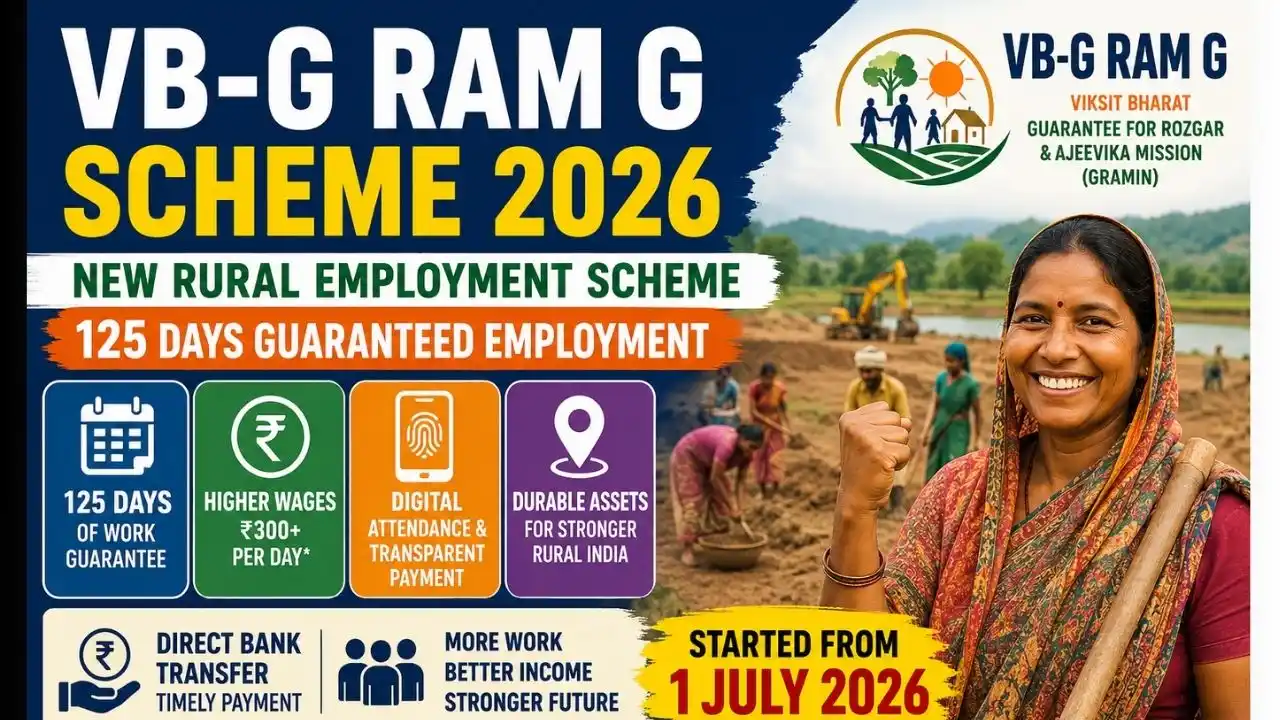
The VB-G RAM G Scheme (Viksit Bharat – Guarantee for Rozgar and Ajeevika Mission – Gramin) is India’s new rural employment guarantee programme that officially came into effect on 1 July 2026. The scheme replaces the long-running MGNREGA programme and introduces several major reforms aimed at strengthening rural livelihoods, increasing employment opportunities, and creating durable village infrastructure.
One of the biggest highlights of the VB-G RAM G Scheme is the increase in guaranteed employment from 100 days to 125 days per financial year for eligible rural households. Along with more workdays, the government has also increased daily wages by more than 10% on average across India, providing better income security to millions of rural workers.
The programme also focuses on digital transparency, faster wage payments, improved planning through Gram Panchayats, climate-resilient infrastructure, and stronger accountability.
In this detailed guide, you will learn everything about the VB-G RAM G Scheme, including its objectives, benefits, eligibility criteria, wage rates, application process, required documents, latest changes, and how it differs from MGNREGA.
What is the VB-G RAM G Scheme?
The VB-G RAM G Scheme stands for Viksit Bharat – Guarantee for Rozgar and Ajeevika Mission (Gramin). It is a rural employment guarantee programme launched by the Government of India under the Ministry of Rural Development.
The scheme was introduced through the VB-G RAM G Act, 2025 and became operational nationwide from 1 July 2026, replacing MGNREGA.
The primary objective of the scheme is to:
- Provide guaranteed wage employment
- Improve rural livelihoods
- Build productive community assets
- Strengthen village infrastructure
- Increase household income
- Promote sustainable rural development
Unlike the earlier programme, the new scheme places greater emphasis on technology-driven implementation, transparency, accountability, and long-term rural development.
Objectives of the VB-G RAM G Scheme
The Government introduced this programme to make rural employment more effective and future-ready.
The major objectives include:
- Guarantee up to 125 days of wage employment
- Increase rural household income
- Reduce seasonal unemployment
- Create durable public infrastructure
- Improve water conservation projects
- Support agriculture through rural assets
- Promote climate-resilient development
- Strengthen Panchayat-level planning
- Ensure transparent digital monitoring
- Provide timely wage payments through Direct Benefit Transfer (DBT)
The government also aims to align the programme with the long-term vision of Viksit Bharat 2047.
Key Features of the VB-G RAM G Scheme
The scheme introduces several important improvements compared to the previous employment programme.
Some of the major features include:
1. 125 Days Employment Guarantee
Eligible rural households can receive up to 125 days of wage employment every financial year instead of the previous 100 days.
2. Higher Daily Wages
The Government has increased wage rates by an average of more than 10%, with many states now having a minimum wage floor of ₹300 per day. Actual wages vary by state.
3. Digital Attendance
Attendance at worksites is expected to be recorded digitally using biometric verification or face authentication to reduce fraud and improve transparency.
4. Direct Bank Transfer
Wages are transferred directly into beneficiaries’ bank accounts through DBT.
5. Asset Creation
The scheme focuses on creating durable assets like:
- Rural roads
- Check dams
- Water harvesting structures
- Farm ponds
- Irrigation channels
- Plantation projects
- Flood protection works
6. Geo-tagging
Completed projects are geo-tagged for better monitoring and accountability.
Benefits of the VB-G RAM G Scheme
The scheme provides several benefits for rural families.
Increased Employment
The extension from 100 to 125 days provides more earning opportunities for rural households.
Better Wages
Higher wage rates help families cope with inflation and improve living standards.
Rural Infrastructure Development
The programme supports construction of productive assets that benefit villages for years.
Transparent Payments
Direct bank transfers reduce payment delays and corruption.
Women’s Participation
Like the previous programme, women are expected to continue receiving equal wages and significant participation opportunities.
Agricultural Support
Water conservation and irrigation projects improve agricultural productivity.
Climate Resilience
The scheme promotes sustainable development through environmental conservation works.
Eligibility Criteria for VB-G RAM G Scheme
Applicants must satisfy the following conditions:
- Must be an Indian citizen.
- Must belong to a rural household.
- Applicant should be at least 18 years old.
- Adult family members must be willing to perform unskilled manual work.
- Household should register with the Gram Panchayat.
- Aadhaar and bank account should be linked where required.
Local authorities verify eligibility before issuing or updating job cards.
Documents Required
Applicants generally need:
- Aadhaar Card
- Residence Certificate
- Job Card (or registration details)
- Bank Passbook
- Mobile Number
- Passport-size Photograph
- Identity Proof
- Family Details
State governments may ask for additional documents if necessary.
How to Apply for the VB-G RAM G Scheme
The application process is expected to remain largely similar to the earlier rural employment system.
Step 1
Visit your Gram Panchayat office.
Step 2
Submit the registration application.
Step 3
Provide Aadhaar and bank account details.
Step 4
Complete e-KYC if required.
Step 5
Receive or update your Job Card.
Step 6
Submit a request for employment.
Step 7
Once work is allotted, report to the assigned worksite.
Many states are also expected to support digital applications through Common Service Centres (CSCs) and state rural development portals.
Daily Wage Under the VB-G RAM G Scheme
One of the biggest changes is the increase in wage rates.
According to the latest government notification:
- Average wage has increased by over 10%.
- National average daily wage is around ₹327, compared with about ₹299 earlier.
- Several states now have a minimum wage floor of ₹300 per day, while actual rates vary by state.
Workers receive wages directly into their linked bank accounts after work verification.
Major Differences Between MGNREGA and VB-G RAM G Scheme
| Feature | MGNREGA | VB-G RAM G |
|---|---|---|
| Employment Guarantee | 100 Days | 125 Days |
| Launch | 2005 | 2026 |
| Wage Rates | Lower | Increased |
| Attendance | Manual + Digital | Greater digital and biometric use |
| Monitoring | Limited | Geo-tagging & digital tracking |
| Focus | Employment | Employment + livelihood + durable assets |
| Technology | Moderate | Extensive digital implementation |
The new framework also changes aspects of funding and implementation while aiming for a smoother transition from the previous programme.
Important Latest Updates
The Government has announced several important updates:
- The scheme officially started from 1 July 2026.
- Employment guarantee has increased to 125 days.
- Daily wages have been revised upward across states.
- Existing beneficiaries are expected to transition without disruption.
- Digital attendance and e-KYC requirements are being expanded.
- The Union Budget has allocated approximately ₹95,692 crore for the programme in FY 2026–27.
Some provisions, including funding arrangements and implementation rules, have also generated political debate in certain states.
Frequently Asked Questions (FAQs) VB-G RAM G Scheme
– What is the VB-G RAM G Scheme?
It is India’s new rural employment guarantee programme that replaced MGNREGA from 1 July 2026.
– How many days of employment are guaranteed?
Eligible rural households can receive up to 125 days of wage employment each financial year.
– Who can apply?
Any eligible rural household with adult members willing to perform unskilled manual work can apply through the Gram Panchayat.
– What is the daily wage?
Daily wages vary by state. The national average has increased to about ₹327 per day, with many states having a ₹300 minimum wage floor.
– Is online registration available?
Many states are expected to facilitate online services through state portals and Common Service Centres, while Gram Panchayats remain the primary registration point.
– Does the old Job Card remain valid?
The government has stated that the transition from MGNREGA to VB-G RAM G is intended to be seamless for existing workers, with administrative updates handled during implementation.
Conclusion
The VB-G RAM G Scheme marks one of the most significant reforms in India’s rural employment policy in over two decades. By replacing MGNREGA with a framework that guarantees 125 days of employment, offers higher wages, promotes digital transparency, and focuses on durable rural infrastructure, the government aims to strengthen livelihood security for millions of rural households.
For eligible families, the scheme provides not only increased earning opportunities but also improved access to timely wage payments, better worksite management, and long-term community assets. As implementation progresses across states, beneficiaries should stay in touch with their Gram Panchayat or local rural development office for the latest state-specific wage rates, registration updates, and work opportunities. By understanding the eligibility rules, documentation requirements, and application process, rural households can make the most of the benefits available under the VB-G RAM G Scheme.
Also read:-
- PM Surya Ghar Scheme Details Assam 2026: Online Apply, Subsidy, Registration, Vendor List, Price List & Complete Guide

AG is a content writer and researcher at Assam Guwahati, focusing on government schemes, Assam-related updates, education, finance, and public welfare programs. Through assamguwahati.com, he publishes informative articles, guides, and scheme updates to help readers understand benefits, eligibility requirements, and application procedures.