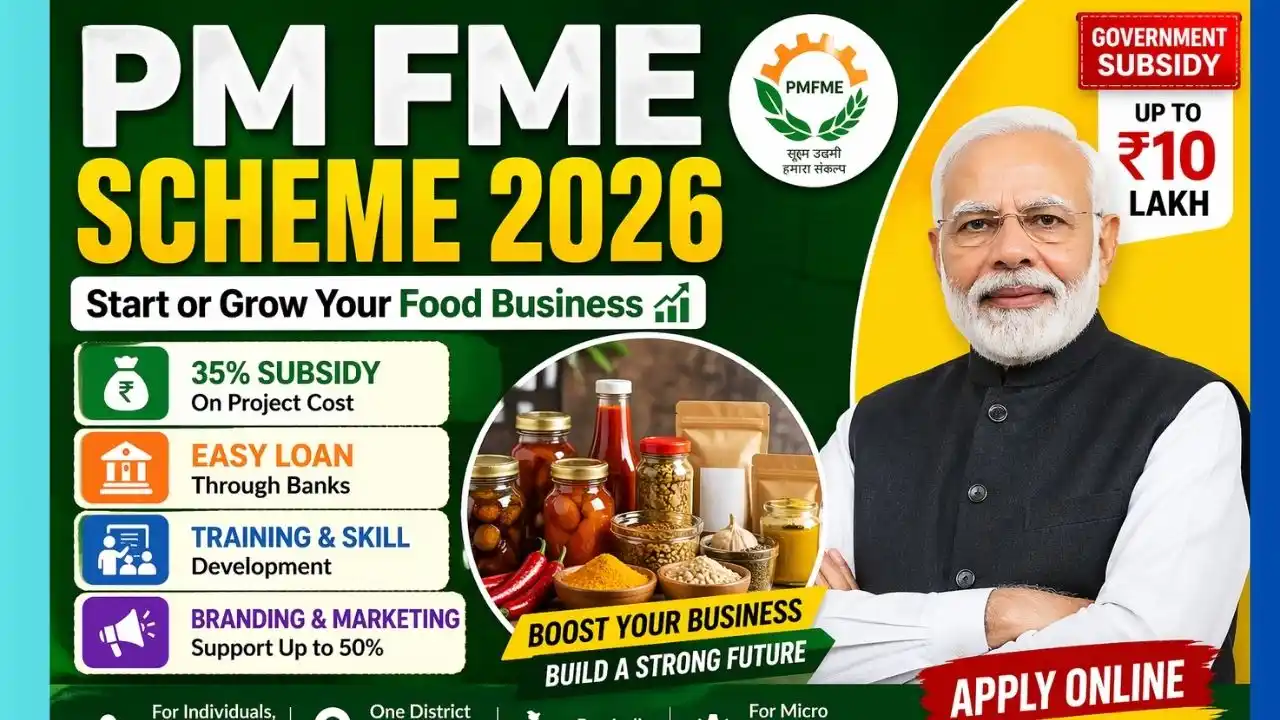
If you’re planning to start or expand a small food business in India, the PM FME Scheme 2026 is one of the most practical and result-oriented government initiatives you can rely on. From homemade pickle units and spice grinding businesses to bakeries and small-scale food packaging units, this scheme is built to support micro-level entrepreneurs who want to turn their ideas into structured, profitable businesses.
Here’s what makes this scheme stand out. It’s not just about financial help. It combines subsidy, bank loan support, skill training, branding assistance, and market access into a single framework. That’s a big deal, especially for small business owners who usually struggle with funding and visibility.
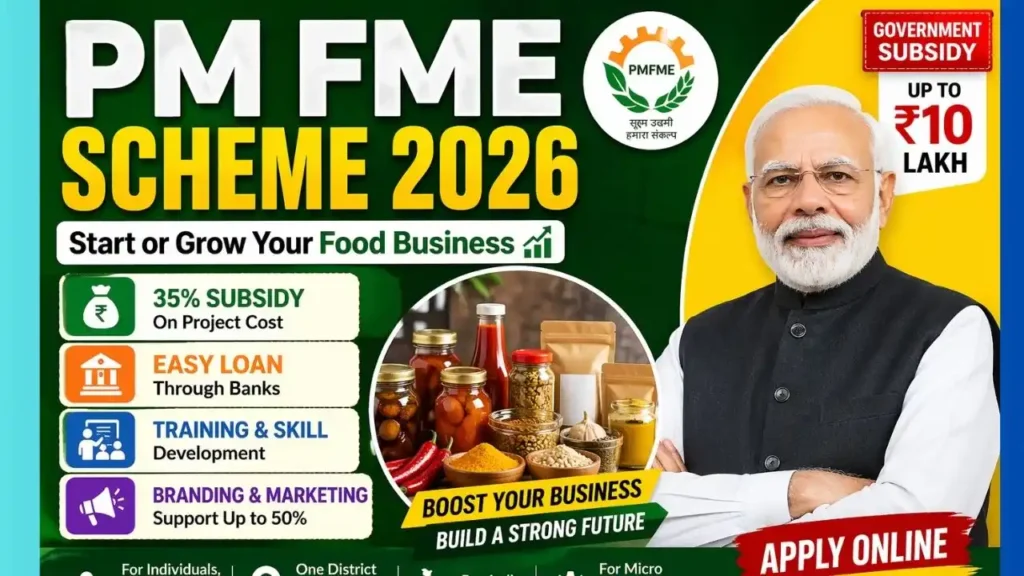
Under this scheme, eligible applicants can get up to 35% subsidy on project cost (maximum ₹10 lakh). On top of that, you also get access to training programs and support for improving product quality and packaging.
The goal is simple. Help small food businesses move from informal setups to organized enterprises that can compete in the market.
In this complete guide, you’ll understand everything about the PM FME Scheme 2026, including eligibility criteria, subsidy amount, loan details, application process, last date, and latest updates.
What is PM FME Scheme?
The PM FME Scheme (Pradhan Mantri Formalisation of Micro Food Processing Enterprises) was launched in 2020 by the Ministry of Food Processing Industries. It focuses on strengthening India’s unorganized food processing sector.
Let me explain why this matters.
India has millions of small food businesses, but most of them operate without proper branding, funding, or legal structure. This limits their growth. The PMFME scheme addresses exactly that gap.
Key Objectives of PM FME Scheme
- Transform informal food businesses into formal enterprises
- Provide financial assistance and bank-linked subsidy
- Improve product quality and standardization
- Promote branding and marketing
- Support local products under the One District One Product (ODOP) initiative
The scheme operates with a budget of around ₹10,000 crore and covers all states and union territories.
Bottom line: it’s designed to make small food businesses sustainable and scalable.
PMFME Scheme Highlights
Before diving deeper, here’s a quick snapshot of the PM FME Scheme 2026:
- Scheme Name: PMFME Scheme
- Launched By: Ministry of Food Processing Industries
- Subsidy: 35% (maximum ₹10 lakh)
- Beneficiaries: Individuals, SHGs, FPOs, Cooperatives
- Sector: Food Processing
- Coverage: All India
- Focus: Micro Enterprises
This scheme is especially beneficial for rural entrepreneurs, women, and self-help groups looking to build income sources.
PM FME Scheme Eligibility
Understanding PM FME Scheme eligibility is crucial before applying. Many applications get rejected simply because basic criteria are not met.
For Individual Applicants
You can apply if:
- You are at least 18 years old
- You are involved in food processing or planning to start one
- You have a valid Aadhaar card and bank account
- Only one person per family can apply
- Your business falls under the micro enterprise category
For SHGs, FPOs & Cooperatives
- Must be a registered organization
- Should be engaged in food processing activities
- Eligible for seed capital and infrastructure support
Additional Conditions
- Applicant must be an Indian citizen
- Minimum education (in some cases): 8th pass
- Both new and existing businesses are eligible
Here’s what matters most: your business idea must be viable and related to food processing.
PM FME Scheme Amount (Subsidy Details)
The PM FME scheme amount is one of the biggest reasons why people apply. Let’s break it down clearly so there’s no confusion.
1. Credit Linked Subsidy
- Subsidy: 35% of total project cost
- Maximum subsidy: ₹10 lakh
- Minimum contribution by applicant: 10%
- Remaining amount covered by bank loan
Example:
If your project cost is ₹20 lakh:
- Subsidy = ₹7 lakh
- Remaining = Bank loan + your contribution
2. Seed Capital for SHGs
- ₹40,000 per member
- Used for working capital and small tools
3. Branding & Marketing Support
- Up to 50% grant
- Covers packaging, labeling, and promotion
4. Infrastructure Support
- Up to ₹3 crore subsidy for groups
- Used for common processing facilities
The key takeaway: the scheme reduces your financial burden significantly, making it easier to start or scale your business.
PMFME Loan Details
The PMFME loan is closely linked with the subsidy. You don’t receive the entire amount directly. Instead, it works as a combination of bank loan and subsidy.
Loan Features
- Provided by public and private banks
- Subsidy is linked with the loan
- Interest rate depends on bank policies
- Repayment period usually ranges from 3 to 7 years
Important Points
- Bank evaluates your project report carefully
- Your credit history plays a role
- Collateral may be required for higher loan amounts
In simple terms, the government reduces your loan burden by covering a portion through subsidy.
How to Apply for PMFME Scheme (Step-by-Step)
If you’re searching for how to apply for PMFME scheme, here’s the exact step-by-step process.
Step 1: Visit Official Website
Go to the official PMFME portal.
Step 2: Registration
Sign up using your mobile number.
Step 3: Fill Application Form
Enter details like:
- Personal information
- Business plan
- Project cost
Step 4: Upload Documents
You need to upload:
- Aadhaar Card
- PAN Card
- Project Report
- Bank Details
Step 5: Submit Application
Step 6: District Review
Your application is reviewed at the district level.
Step 7: Bank Processing
Loan is evaluated and approved by the bank.
Step 8: Subsidy Release
Subsidy is credited after approval.
Here’s what matters: a strong and realistic project report can significantly improve approval chances.
PMFME Scheme Apply Online
The PM FME scheme apply online process is fully digital, which makes things easier and more transparent.
You can:
- Register online
- Upload documents
- Track application status
- Receive approval updates
This eliminates the need for multiple office visits and speeds up the process.
PMFME Scheme List PDF
Many applicants look for the PMFME Scheme list PDF, and for good reason.
This document usually contains:
- District-wise ODOP products
- Eligible food processing activities
- Priority sectors
Why This PDF is Important
Projects linked to ODOP (One District One Product) get higher priority.
What You’ll Find Inside
- Popular food products in your district
- Business opportunities
- Processing and packaging ideas
Downloading and reviewing this PDF helps you choose the right business idea.
PMFME Scheme Last Date
A common question is about the PMFME scheme last date.
Here’s the real situation:
- There is no fixed national deadline
- Applications are open most of the year
- States may set their own targets
What You Should Do
Apply early instead of waiting.
Why? Because approvals often depend on district targets and funding availability.
PMFME Scheme Extension (Latest Update 2026)
Originally, the scheme was planned from 2020 to 2024-25. However, due to strong demand and success, discussions about PMFME scheme extension have been ongoing.
Latest Trend
- Government continues funding support
- States are actively encouraging new applications
- Likely continuation under future MSME programs
Bottom line: the scheme is still active and relevant in 2026.
Benefits of PM FME Scheme
Let’s get straight to the value this scheme offers.
1. Financial Support
Up to ₹10 lakh subsidy reduces your investment burden.
2. Skill Training
Entrepreneurs receive training to improve business operations.
3. Branding Assistance
Support for packaging, labeling, and marketing.
4. Local Business Promotion
Encourages regional products through ODOP.
5. Employment Generation
Creates jobs in rural and semi-urban areas.
6. Women Empowerment
Strong focus on SHGs and women entrepreneurs.
This isn’t just a funding scheme. It’s a complete business development program.
Documents Required
To apply successfully, keep these documents ready:
- Aadhaar Card
- PAN Card
- Bank Passbook
- Project Report
- Address Proof
- Business Registration (if available)
- Passport-size photographs
A well-prepared project report can make a huge difference in approval.
Types of Projects Allowed
The scheme supports a wide range of food processing businesses.
Examples
- Pickle manufacturing
- Spice processing units
- Bakery businesses
- Dairy processing
- Oil extraction units
- Food packaging
- Cold storage and logistics
If your business is related to food processing at a micro level, chances are it qualifies.
Frequently Asked Questions (FAQs) PM FME Scheme
– What is the main benefit of the PM FME Scheme?
The biggest benefit of the PM FME Scheme is the 35% subsidy on project cost (up to ₹10 lakh). Along with that, you also get training, branding support, and access to bank loans. It’s not just funding, it’s complete business support.
– Is there any last date to apply for PMFME Scheme?
There is no fixed national last date. Applications are open most of the year, but states may have their own targets. Applying early improves your chances of approval.
– Do I need collateral for PMFME loan?
It depends on the loan amount and bank policy. Smaller loans may not require collateral, but larger loans usually do. The bank decides this based on your project and credit profile.
– Can I apply for PMFME Scheme online?
Yes, the PM FME Scheme apply online process is completely digital. You can register, submit documents, and track your application through the official portal without visiting multiple offices.
Conclusion
The PM FME Scheme 2026 is one of the most practical government schemes available for small entrepreneurs in India.
- You get financial support up to ₹10 lakh subsidy
- You get access to training and branding support
- You get formal banking and business structure
For anyone serious about starting or expanding a food business, this scheme provides a strong foundation.
Instead of waiting for the perfect opportunity, you can use PMFME to reduce risk, access funding, and build a sustainable business.
If you approach it with a clear plan and proper documentation, this scheme can turn a small idea into a real income-generating enterprise.
Also read:-

AG is a content writer and researcher at Assam Guwahati, focusing on government schemes, Assam-related updates, education, finance, and public welfare programs. Through assamguwahati.com, he publishes informative articles, guides, and scheme updates to help readers understand benefits, eligibility requirements, and application procedures.