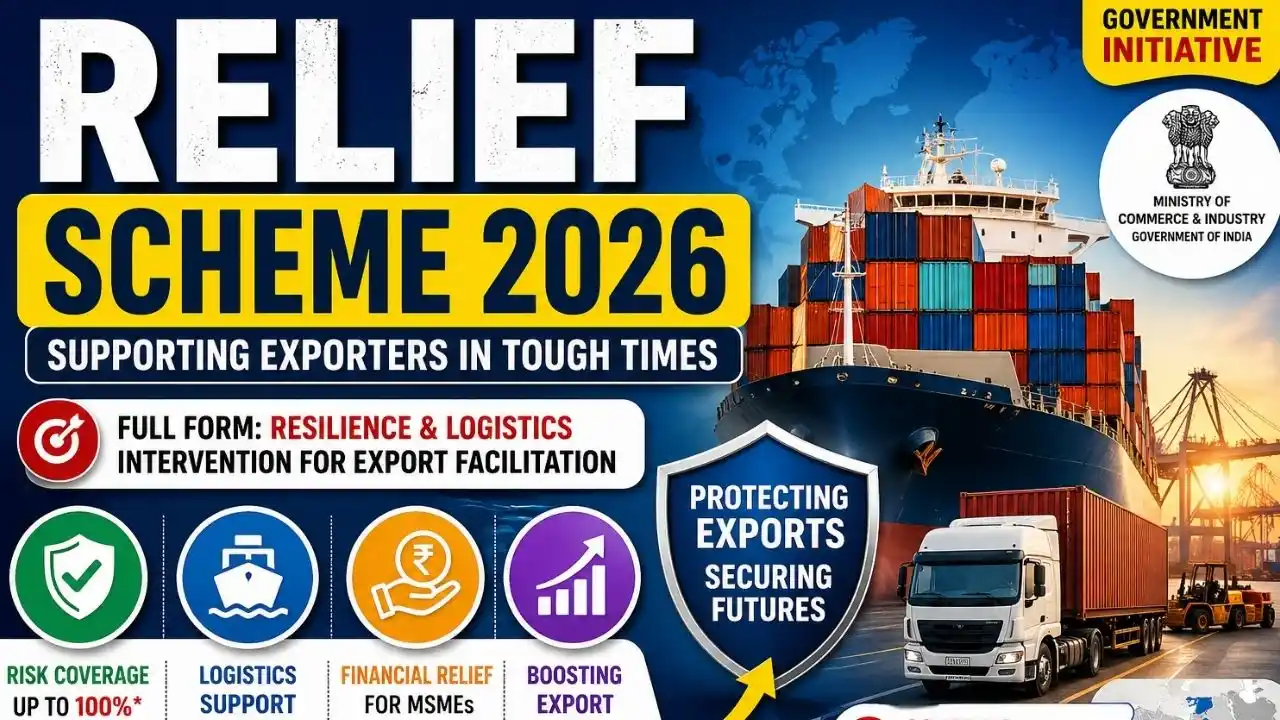
India’s export sector is one of the strongest pillars of the economy. It drives foreign exchange earnings, creates millions of jobs, and connects Indian businesses to global markets. But here’s the reality exports are highly sensitive to global disruptions. When geopolitical tensions rise, everything from shipping routes to insurance costs can change overnight.
That’s exactly what happened during the West Asia crisis in 2026. Freight charges surged, insurance premiums shot up, and exporters especially small businesses were left exposed to serious financial risks. Many were on the verge of cancelling shipments or halting operations altogether.
To address this situation, the Government of India stepped in with a targeted policy intervention the RELIEF Scheme 2026.
This scheme is not just another export incentive. It is a crisis-response framework designed to protect exporters from unexpected global shocks. In this detailed guide, you’ll understand the RELIEF scheme full form, objectives, features, benefits, UPSC relevance, and the latest updates in a simple, practical way.
RELIEF Scheme Full Form
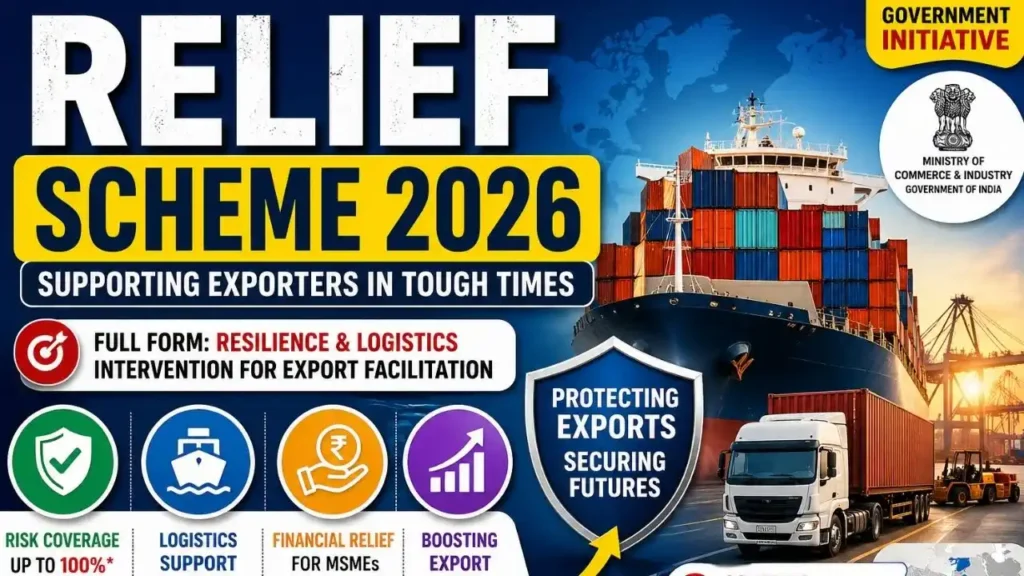
The RELIEF scheme full form is:
Resilience & Logistics Intervention for Export Facilitation
The name itself clearly reflects the intent of the scheme. It focuses on three core areas:
- Strengthening resilience in India’s export sector
- Reducing logistics-related challenges
- Providing immediate support during global disruptions
Unlike traditional export schemes, RELIEF is designed specifically for emergency situations. It ensures that exporters don’t suffer heavy losses due to factors beyond their control.
RELIEF Scheme Details
| Feature | Details |
|---|---|
| Scheme Name | RELIEF Scheme 2026 |
| Full Form | Resilience & Logistics Intervention for Export Facilitation |
| Launch Date | 19 March 2026 |
| Ministry | Ministry of Commerce and Industry |
| Nodal Agency | Export Credit Guarantee Corporation of India (ECGC) |
| Type of Scheme | Time-bound crisis support scheme |
| Total Outlay | ₹497 Crore (approx.) |
| Target Group | Exporters, especially MSMEs |
| Main Objective | Protect exporters from global disruptions and financial losses |
| Key Issue Addressed | High freight cost, insurance premium, war-related risks |
| Component I | 100% risk coverage for existing ECGC-insured exporters |
| Component II | 95% risk coverage for future exports (Mar–Jun 2026) |
| Component III | 50% reimbursement for MSMEs (max ₹50 lakh) |
| Coverage Regions | West Asia & Gulf countries |
| Additional Countries (2026) | Egypt, Jordan |
| Support Type | Insurance coverage + cost reimbursement |
| UPSC Relevance | Prelims (facts) + GS Paper III (Economy) |
| Nature of Scheme | Emergency export support (not regular incentive) |
| Duration | Short-term / temporary |
| Key Benefit | Ensures export continuity during crisis |
What is RELIEF Scheme 2026?
The RELIEF Scheme 2026 is a time-bound government initiative launched under the Export Promotion Mission (EPM). It aims to support exporters affected by geopolitical tensions, particularly in West Asia.
The scheme was officially launched on 19 March 2026 with a financial outlay of approximately ₹497 crore.
Here’s what triggered the scheme:
- Rising freight costs due to disrupted shipping routes
- Increased insurance premiums because of war risks
- Delays in shipments and supply chain breakdowns
- Higher operational uncertainty for exporters
In simple terms, the RELIEF scheme acts as a financial safety net. It ensures that exporters can continue their business operations without bearing the full burden of global disruptions.
RELIEF Scheme Ministry and Implementation
The scheme is managed by the:
Ministry of Commerce and Industry (Government of India)
The actual implementation is handled by:
Export Credit Guarantee Corporation of India (ECGC)
ECGC plays a central role in the scheme. It is responsible for:
- Providing export credit insurance
- Managing risk coverage
- Settling claims
- Ensuring smooth disbursement of benefits
This structure helps reduce delays and ensures that exporters receive timely support when they need it the most.
Objectives of the RELIEF Scheme
Here’s what really matters the scheme is built around clear and practical objectives.
1. Protect Exporters from Financial Loss
Global conflicts increase risks and costs. The scheme helps exporters recover losses caused by:
- War-related disruptions
- Increased insurance premiums
- Sudden cost escalations
2. Maintain Export Competitiveness
Without support, Indian exporters could lose global market share. RELIEF ensures they remain competitive despite rising costs.
3. Ensure Supply Chain Stability
The scheme helps maintain smooth export operations even during disruptions by reducing logistical pressure.
4. Support MSME Exporters
Small exporters are the most vulnerable. RELIEF specifically targets MSMEs with financial assistance and cost-sharing benefits.
5. Prevent Job Losses
Export industries employ millions. By stabilizing exports, the scheme indirectly protects employment.
Key Features of RELIEF Scheme
The RELIEF scheme follows a three-component structure. Each component targets a specific category of exporters.
Component I – Support for Existing Exporters
This component is for exporters already covered under ECGC insurance.
- Up to 100% risk coverage for war-related losses
- No increase in existing insurance premium rates
- Covers shipments already in transit
This ensures that exporters don’t suffer losses from ongoing transactions.
Component II – Support for Future Exports
This part focuses on upcoming shipments.
- Up to 95% risk coverage
- Applicable for shipments between March to June 2026
- Includes new exporters opting for ECGC policies
This encourages exporters to continue operations instead of stopping due to uncertainty.
Component III – MSME Relief Support
This is one of the most impactful parts of the scheme.
- Designed for exporters without insurance
- Provides 50% reimbursement of additional freight and insurance costs
- Maximum benefit capped at ₹50 lakh per exporter
This component ensures that small businesses are not left behind.
Coverage and Eligible Regions
The RELIEF scheme mainly targets exports to West Asia and Gulf countries, which were directly affected by geopolitical tensions.
Key regions include:
- United Arab Emirates (UAE)
- Saudi Arabia
- Qatar
- Oman
- Kuwait
- Bahrain
- Iraq
- Iran
- Yemen
In April 2026, the government expanded coverage to include:
- Egypt
- Jordan
This expansion shows that the scheme is flexible and responsive to changing global conditions.
RELIEF Scheme PIB Updates
According to official government updates:
- The scheme was expanded due to ongoing geopolitical tensions
- Both past and future shipments are covered
- ECGC policies issued after March 2026 are eligible
- The government may revise the scheme based on global developments
This makes RELIEF a dynamic policy rather than a static one.
RELIEF Scheme for Exporters: UPSC Perspective
If you’re preparing for UPSC, this scheme is highly relevant.
Prelims Key Points
- Full form: Resilience & Logistics Intervention for Export Facilitation
- Ministry: Commerce and Industry
- Nodal agency: ECGC
- Launch year: 2026
- Focus: Export support during geopolitical disruptions
Mains Relevance (GS Paper III)
You can use this scheme in answers related to:
- Export promotion strategies
- Supply chain resilience
- Government intervention in trade
- MSME support policies
Sample Question
Discuss the role of the RELIEF scheme in ensuring export resilience during global crises.
Benefits of RELIEF Scheme in India
Let’s break this down in practical terms.
1. Financial Protection
Exporters are protected from:
- War-related risks
- Unexpected insurance losses
- Sudden cost increases
2. Continuity in Trade
Instead of cancelling shipments, exporters can continue operations even during crises.
3. Boost for MSMEs
Small exporters receive:
- Cost reimbursement
- Risk coverage
- Financial stability
4. Export Stability
The scheme prevents a sharp decline in exports during global disruptions.
5. Confidence Building
Perhaps the biggest benefit confidence. Exporters feel secure enough to take business decisions without fear of sudden losses.
RELIEF Scheme vs Other Export Schemes
India has several export promotion schemes, but RELIEF stands apart.
| Feature | RELIEF Scheme | Traditional Schemes |
|---|---|---|
| Purpose | Crisis support | Incentives |
| Duration | Time-bound | Long-term |
| Focus | Risk mitigation | Cost benefits |
| Target | Affected exporters | All exporters |
In short, RELIEF is an emergency response mechanism, not a regular incentive scheme.
RELIEF Scheme PDF and Official Documents
If you’re looking for official details, you can refer to:
- Press Information Bureau (PIB) releases
- Ministry of Commerce website
- ECGC notifications
These documents include:
- Eligibility criteria
- Application process
- Policy guidelines
Challenges of RELIEF Scheme
No policy is perfect. Here are some limitations.
1. Limited Duration
The scheme is temporary and may not cover long-term disruptions.
2. Geographic Focus
It mainly targets West Asia, not all global markets.
3. Awareness Issues
Many small exporters may not fully understand the scheme or how to apply.
4. Dependency on ECGC
Exporters without prior insurance may face initial barriers.
Future Scope of RELIEF Scheme
Looking ahead, the scheme has strong potential for expansion.
Possible improvements include:
- Extending coverage to other regions
- Increasing duration during prolonged crises
- Integration with digital trade systems
- More support for startups and new exporters
Given the current global environment, such crisis-response schemes may become more common.
Why RELIEF Scheme Matters in 2026
Here’s what matters most.
The RELIEF scheme is not just about exporters. It plays a much larger role in:
- Protecting India’s position in global trade
- Supporting millions of jobs
- Ensuring economic stability
- Strengthening supply chain resilience
In a world where disruptions are becoming frequent, policies like RELIEF are no longer optional they are essential.
RELIEF Scheme F.A.Q.
– What is the RELIEF Scheme 2026?
The RELIEF Scheme 2026 is a government initiative launched to support Indian exporters affected by global disruptions, especially geopolitical tensions in West Asia. It provides financial protection against rising freight costs, insurance premiums, and war-related risks, ensuring that export activities continue smoothly during crises.
– What is the full form of the RELIEF Scheme?
The full form of the RELIEF Scheme is Resilience & Logistics Intervention for Export Facilitation. The scheme focuses on strengthening export resilience, reducing logistics challenges, and supporting exporters during uncertain global conditions.
– Who implements the RELIEF Scheme in India?
The RELIEF Scheme is implemented by the Export Credit Guarantee Corporation of India (ECGC) under the supervision of the Ministry of Commerce and Industry. ECGC handles insurance coverage, claim settlements, and disbursement of benefits to exporters.
– Why is the RELIEF Scheme important for UPSC preparation?
The RELIEF Scheme is important for UPSC because it is a recent government initiative related to economic policy and export promotion. It is relevant for Prelims (factual questions) and Mains GS Paper III (economy, trade, and MSME support). Understanding this scheme helps in writing answers on supply chain resilience and government intervention during global crises.
Conclusion
The RELIEF Scheme 2026 is a timely and well-targeted initiative by the Government of India. It directly addresses the challenges faced by exporters during global crises, especially in volatile regions like West Asia.
With its strong focus on risk coverage, logistics support, and MSME assistance, the scheme ensures that exports continue even under pressure. It protects businesses, safeguards jobs, and stabilizes the economy during uncertain times.
For UPSC aspirants, this scheme is important from both prelims and mains perspectives. For exporters, it offers real financial relief. And for policymakers, it sets an example of how governments can respond quickly to global shocks.
Also read:-

AG is a content writer and researcher at Assam Guwahati, focusing on government schemes, Assam-related updates, education, finance, and public welfare programs. Through assamguwahati.com, he publishes informative articles, guides, and scheme updates to help readers understand benefits, eligibility requirements, and application procedures.