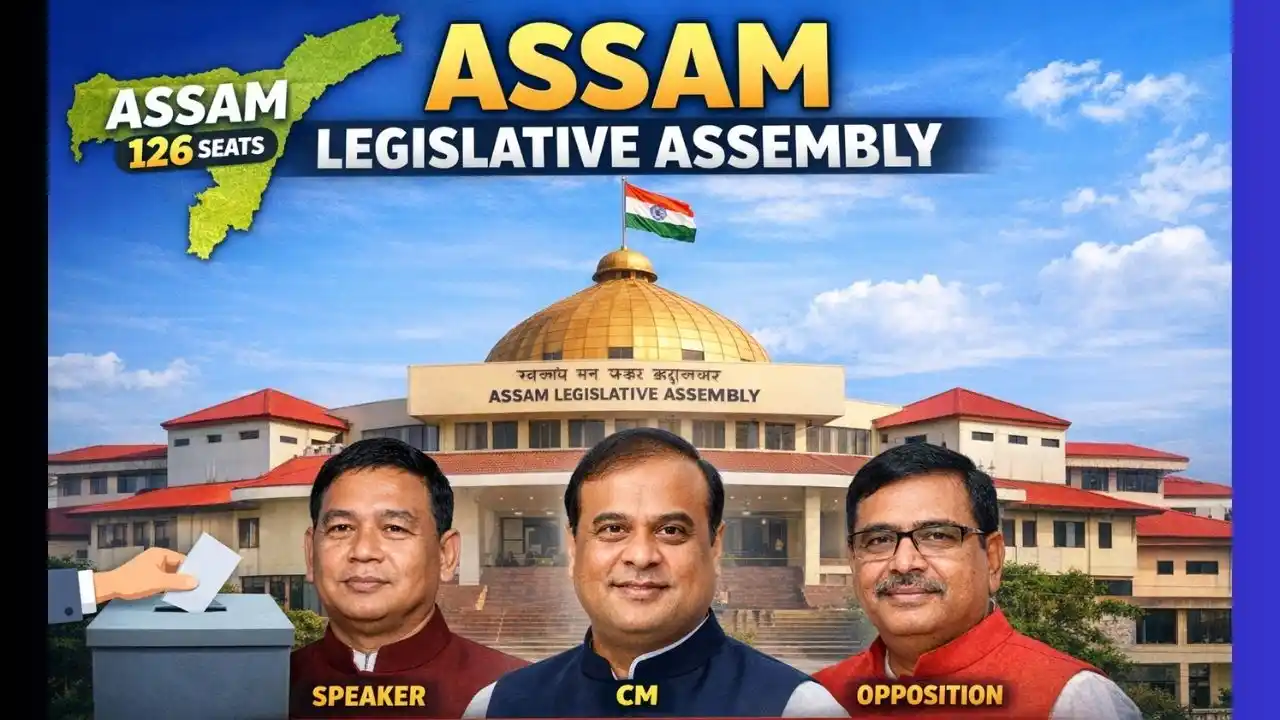
The Assam Legislative Assembly sits at the core of the state’s democratic system. It is where laws are written, budgets are debated, governments are tested, and public voices find formal representation. While national politics often dominates headlines, the decisions taken inside the Assam Assembly affect everyday life far more directly from land rights and welfare schemes to education policy and law and order.
If you want to understand how Assam is governed, you have to understand its Legislative Assembly. This guide breaks it down clearly: how the Assembly works, how many seats it has, who runs it, who the members are, and how elections shape its future with the latest updates heading into the 2026 election.

What Is the Assam Legislative Assembly?
The Assam Legislative Assembly is the unicameral legislature of the state of Assam. Unicameral means it has only one house, unlike Parliament at the national level, which has two houses Lok Sabha and Rajya Sabha.
This single house is responsible for making laws on subjects that fall under the State List and Concurrent List of the Indian Constitution. These include agriculture, public health, police, state taxation, local government, land reforms, and welfare programs. In practical terms, many of the policies that shape daily life in Assam originate here.
Constitutional Role and Authority
The Assembly derives its authority from Article 168 of the Indian Constitution, which allows states to have their own legislatures. Once elected, the Assembly functions as long as it enjoys the confidence of the majority of its members. If that confidence collapses, the government can fall even before the five-year term ends.
Every bill passed by the Assembly must be approved by the Governor to become law. However, the real power lies with elected representatives, not the Governor. Debates, voting, committee reviews, and questioning of ministers all happen on the Assembly floor.
How the Assembly Functions Day to Day
The Assembly meets in sessions usually Budget Session, Monsoon Session, and Winter Session. During these sessions:
- Ministers introduce bills and defend policies
- MLAs ask questions and demand accountability
- Opposition parties challenge government decisions
- Budgets and supplementary grants are debated
- Committees review laws in detail
This is not ceremonial politics. Heated debates, walkouts, amendments, and negotiations are part of the process. The Assembly is where power is tested publicly.
Why It Matters to Ordinary Citizens
It’s easy to assume governance happens far away in Delhi. In reality, decisions made in Dispur often matter more. Whether it’s a new welfare scheme, changes in land ownership rules, or funding for rural roads, the Assam Legislative Assembly has a direct impact.
This is where local problems meet formal power. That’s why understanding this institution matters — especially as Assam moves toward another election cycle.
How Many Seats Are in the Assam Legislative Assembly?
The Assam Legislative Assembly has 126 seats in total.
Each seat represents a single Assembly constituency, and each constituency elects one Member of the Legislative Assembly (MLA). The elections follow the first-past-the-post system, meaning the candidate with the highest number of votes wins – even if they don’t secure an absolute majority.
What the Number 126 Really Means
Those 126 seats are not arbitrary. They are designed to reflect Assam’s population size, geographic spread, and social diversity. From densely populated urban areas to remote hill districts, every region has representation.
Out of these 126 seats:
- Some are general seats, open to all candidates
- Some are reserved for Scheduled Castes (SC)
- Some are reserved for Scheduled Tribes (ST)
This reservation system exists to ensure historically marginalized communities have guaranteed representation in the lawmaking process.
Majority and Government Formation
To form a government, a party or coalition must secure at least 64 seats, which is the simple majority mark.
- If a single party crosses 64 seats, it forms the government alone
- If no party does, alliances and coalitions decide who governs
This is why post-election negotiations matter almost as much as the vote count itself.
Impact of Delimitation
In 2023, Assam underwent a delimitation exercise, which adjusted constituency boundaries based on population changes. While the total number of seats remained 126, boundaries shifted in several regions.
This affects:
- Voter composition
- Political strategies
- Candidate selection
- Regional power balance
Delimitation plays a quiet but decisive role in shaping elections.
Assam Legislative Assembly Constituencies: Full Structure Explained
The 126 Assembly constituencies cover every district and region of Assam. These constituencies are the building blocks of state politics.
Each constituency has:
- Defined geographic boundaries
- A fixed voter list
- One elected MLA
Examples of Assembly Constituencies
Some well-known constituencies include:
- Abhayapuri North
- Abhayapuri South (SC)
- Algapur
- Amguri
- Baithalangso
- Barama
- Bijni
- Dudhnai (ST)
- Goalpara East
- Goalpara West
- Majuli (ST)
- Palasbari
- Rangapara
- Teok
Reserved constituencies like Majuli (ST) or Dudhnai (ST) can only be contested by candidates belonging to Scheduled Tribes. This ensures indigenous and tribal voices remain part of the Assembly.
Link Between Assembly and Lok Sabha Seats
Assembly constituencies are grouped under Lok Sabha constituencies. For example, multiple Assembly segments together form one parliamentary seat.
This alignment matters during national elections, as Assembly-level strength often predicts Lok Sabha outcomes.
Assam Legislative Assembly Speaker and Leadership Structure
The smooth functioning of the Assembly depends heavily on its leadership, especially the Speaker.
Role of the Speaker
The Speaker of the Assam Legislative Assembly is the presiding authority of the House. Their responsibilities include:
- Conducting Assembly sessions
- Maintaining discipline and order
- Deciding which member speaks and when
- Interpreting Assembly rules
- Certifying money bills
The Speaker is expected to act impartially, even though they usually belong to a political party.
Current Speaker of Assam Assembly
As of now, the Speaker is Biswajit Daimary, elected in May 2021. He represents the Panery constituency.
His role places him at the procedural center of Assam’s legislative system. Every debate, disruption, or ruling ultimately passes through the Speaker’s authority.
Other Key Leadership Positions
- Chief Minister (Leader of the House): Himanta Biswa Sarma
- Deputy Speaker: Assists the Speaker
- Leader of the Opposition: Debabrata Saikia (INC)
This leadership structure ensures both government and opposition voices remain active within constitutional boundaries.
Assam Legislative Assembly Members: Who Represents the State
The Assembly consists of 126 MLAs, each elected to represent a specific constituency.
Who Are the MLAs?
MLAs come from diverse backgrounds — lawyers, social workers, teachers, businesspeople, and career politicians. Some are seasoned leaders with decades of experience. Others are first-time representatives.
Major parties represented include:
- Bharatiya Janata Party (BJP)
- Indian National Congress (INC)
- All India United Democratic Front (AIUDF)
- Asom Gana Parishad (AGP)
- United People’s Party Liberal (UPPL)
Examples of Current MLAs
- Abdul Batin Khandakar — Abhayapuri North (INC)
- Pradip Sarkar — Abhayapuri South (SC) (INC)
- Nizamuddin Choudhury — Algapur (AIUDF)
- Prodip Hazarika — Amguri (AGP)
- Rupsing Teron — Baithalangso (BJP)
- Bhupen Baro — Barama (UPPL)
Each MLA carries both legislative and constituency responsibilities.
What MLAs Actually Do
An MLA’s work includes:
- Raising questions in the Assembly
- Participating in debates and committees
- Monitoring implementation of government schemes
- Representing public grievances
- Using constituency development funds
Ultimately, MLAs are accountable to voters. Elections are the final judgment on their performance.
Assam Legislative Assembly Elections: Process and 2026 Update
Elections determine who controls the Assembly and, by extension, the state government.
How Assembly Elections Work
- Elections are held every five years
- Conducted by the Election Commission of India
- Voting is done through Electronic Voting Machines (EVMs)
- Results are declared constituency by constituency
The last Assembly election was held in March–April 2021.
2021 Election Outcome
The 2021 election saw the BJP-led alliance retain power, with Himanta Biswa Sarma becoming Chief Minister. The result reinforced BJP’s dominance in Assam while opposition parties faced setbacks.
Assam Assembly Election 2026: What to Expect
The next election is scheduled for March–April 2026.
Key developments:
- All 126 seats will be contested
- Voter list revisions are underway
- Political parties have begun groundwork
- Candidate selection and alliances are evolving
Assam now has over 2.52 crore registered voters, including a growing youth population. This makes 2026 a high-stakes contest.
Why the 2026 Election Matters
Assam is dealing with complex challenges economic growth, employment, ethnic identity, border issues, and infrastructure demands. The next government will shape policy direction for years.
The election outcome will also influence national politics, especially in the Northeast.
Assam Legislative Assembly F.A.Q.
– How many seats are there in the Assam Legislative Assembly?
The Assam Legislative Assembly has 126 seats in total. Each seat represents one Assembly constituency, and one MLA is elected from each constituency through direct voting. A party or coalition needs 64 seats to form the state government.
– Who is the current Speaker of the Assam Legislative Assembly?
The current Speaker of the Assam Legislative Assembly is Biswajit Daimary. He was elected to the position in May 2021 and represents the Panery constituency. The Speaker is responsible for conducting Assembly sessions and ensuring debates follow constitutional rules.
– What is the term length of the Assam Legislative Assembly?
The normal term of the Assam Legislative Assembly is five years from the date of its first sitting. However, the Assembly can be dissolved earlier if the government loses majority support or under constitutional provisions such as President’s Rule.
– When will the next Assam Legislative Assembly election be held?
The next Assam Legislative Assembly election is expected to be held in March–April 2026. All 126 seats will be contested. Preparations like voter list updates and political party strategies are already underway ahead of the election.
– How is an MLA elected in Assam?
An MLA in Assam is elected through the first-past-the-post system. Voters in each Assembly constituency cast their vote for a candidate, and the candidate who receives the highest number of votes wins, even if they do not secure an absolute majority.
Conclusion: Why the Assam Legislative Assembly Matters More Than Ever
The Assam Legislative Assembly is not just a political institution. It is the state’s democratic engine. With 126 seats, diverse representation, and real legislative power, it shapes Assam’s laws, policies, and future direction. Its members debate, disagree, negotiate, and decide- all in the public eye.
As the 2026 Assembly election approaches, the importance of this institution only grows. Voters will once again decide who represents them, who governs, and what direction Assam takes. Understanding the Assembly is not optional for anyone who cares about Assam’s future. It is where democracy becomes real.
Also read:-

AG is a content writer and researcher at Assam Guwahati, focusing on government schemes, Assam-related updates, education, finance, and public welfare programs. Through assamguwahati.com, he publishes informative articles, guides, and scheme updates to help readers understand benefits, eligibility requirements, and application procedures.