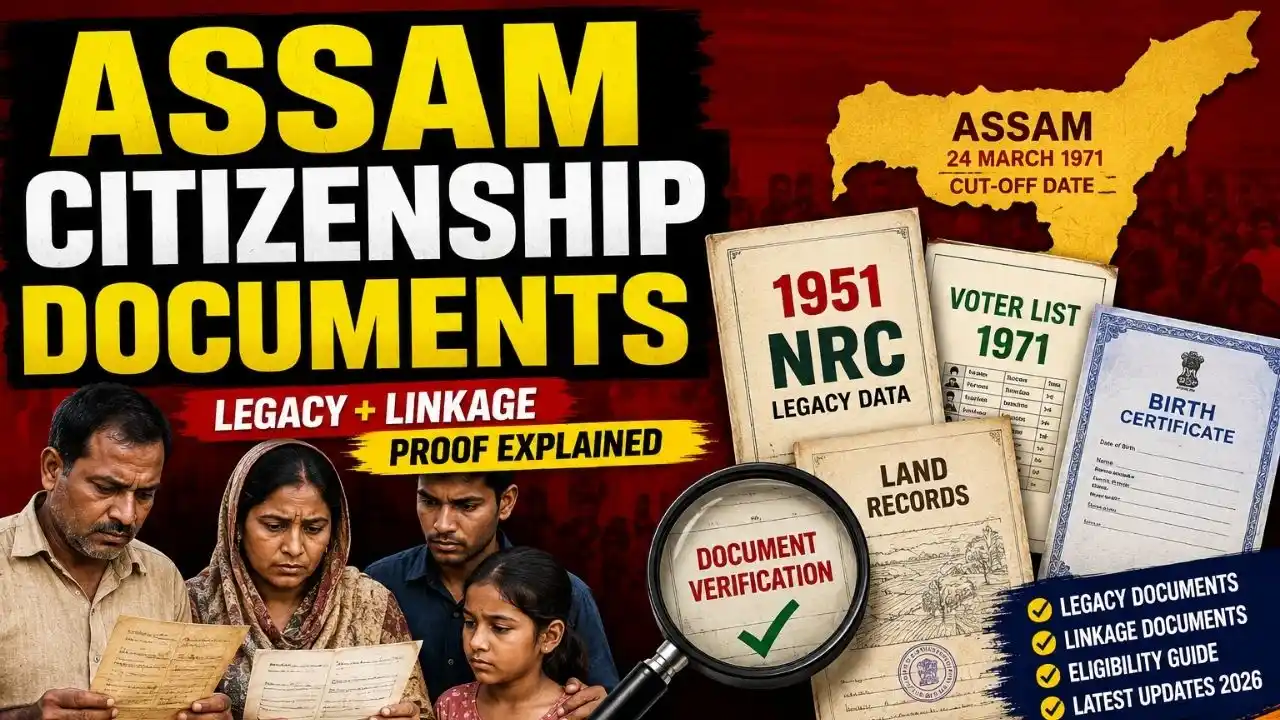
Proving Indian citizenship in Assam requires more than simply possessing identity cards or government-issued documents. The process is governed by the Citizenship Act, the Assam Accord, and the National Register of Citizens (NRC) framework. Applicants must establish that they or their ancestors were residents of India before the prescribed cut-off date and, where applicable, prove their relationship with those ancestors using legally acceptable evidence.
The issue has remained significant because of NRC verification, proceedings before Foreigners Tribunals, and several recent court judgments. In 2024, the Supreme Court upheld the constitutional validity of Section 6A of the Citizenship Act, which forms the legal basis for determining citizenship in Assam under the Assam Accord.
Recent judgments from the Gauhati High Court have also highlighted an important legal principle: producing many documents alone does not automatically establish citizenship. Courts examine whether the documents are legally admissible, genuine, and capable of proving ancestry and family linkage.
This guide explains the complete list of Assam citizenship documentary evidence, the difference between legacy and linkage documents, eligibility requirements, and the latest legal position in simple language.
What is Assam Citizenship Documentary Evidence?
Assam Citizenship Documentary Evidence refers to the official documents accepted by authorities to establish that a person is an Indian citizen under the legal provisions applicable in Assam.
Unlike many other parts of India, citizenship verification in Assam follows special provisions introduced through the Assam Accord. The crucial cut-off date is 24 March 1971 (midnight). Individuals must show that they or their ancestors were present in India before this date or otherwise satisfy the applicable legal requirements.
Generally, documentary evidence falls into two categories:
- Legacy Documents (List A): These establish that the applicant or an ancestor existed in official records before the cut-off date.
- Linkage Documents (List B): These connect the applicant to the ancestor mentioned in the legacy document.
Both categories are important because a pre-1971 record alone is often insufficient if the applicant cannot legally prove the family relationship with the person named in that record.
Authorities verify every document carefully. Information such as names, age, father’s name, village, and family details should remain consistent across records. Even minor inconsistencies may require additional verification.
Recent Gauhati High Court decisions have reaffirmed that documentary evidence must satisfy legal standards and that the burden of proving citizenship lies on the individual in proceedings before a Foreigners Tribunal.
Complete List of Assam Citizenship Documentary Evidence (List A & List B)
To establish Indian citizenship under the NRC framework in Assam, applicants generally need to submit two categories of documents. The first category proves that the applicant or an ancestor was residing in India before the prescribed cut-off date of 24 March 1971 (midnight). The second category establishes the family relationship between the applicant and that ancestor.
List A: Legacy Documents
Any one of the following documents issued on or before 24 March 1971 (midnight) can be used as a Legacy Document:
- 1951 NRC
- Electoral Roll up to 24 March 1971
- Land and Tenancy Records
- Citizenship Certificate
- Permanent Residential Certificate
- Refugee Registration Certificate
- Passport
- LIC Policy
- Government-issued License or Certificate
- Government Service or Employment Certificate
- Bank or Post Office Account Records
- Birth Certificate
- Board or University Educational Certificate
- Court Records or Judicial Proceedings
According to the official NRC guidelines, producing any one valid List A document is sufficient to establish eligibility, provided it is genuine and verifiable. Supporting documents such as a pre-1971 Ration Card or a Circle Officer/Gaon Panchayat Secretary certificate for married women are accepted only along with a primary List A document.
List B: Linkage Documents
If the List A document belongs to a parent, grandparent, or another ancestor rather than the applicant, the applicant must prove the family relationship using one of the following legally acceptable documents:
- Birth Certificate
- Land Document showing family relationship
- Board or University Certificate
- Bank, LIC, or Post Office Records
- Circle Officer or Gaon Panchayat Secretary Certificate (for eligible married women)
- Electoral Roll
- Ration Card
- Any other legally acceptable document establishing lineage
For example, if your father’s name appears in the 1966 Electoral Roll, you may submit your Birth Certificate mentioning your father’s name to establish the required linkage. Authorities verify these documents with the issuing departments before accepting them.
Understanding Legacy Documents and Linkage Documents
Many people mistakenly believe that possessing an Aadhaar Card, PAN Card, or Voter ID alone is enough to prove citizenship. However, under the Assam NRC framework, these documents by themselves do not replace the requirement of proving ancestry before the prescribed cut-off date.
A Legacy Document establishes that either the applicant or an ancestor was present in India before midnight of 24 March 1971. A Linkage Document then connects the applicant to that ancestor through an officially recognized family relationship.
For example:
- Grandfather’s name appears in the 1951 NRC.
- Father’s Birth Certificate and Electoral Roll establish that he is the grandfather’s son.
- Applicant’s Birth Certificate establishes that the applicant is the father’s child.
Together, these documents create a legally verifiable chain of ancestry. Every link in this chain should be supported by authentic and consistent records. If names, ages, or family details differ significantly across documents, authorities may ask for clarification or conduct additional verification.
How to Obtain Assam Citizenship Documentary Evidence
If you need documentary evidence to establish citizenship in Assam, the first step is to identify which documents are already available with you or your family. Many families possess old voter lists, land records, school certificates, or other government-issued records that can serve as legacy or linkage documents.
If the original documents have been lost or damaged due to floods, erosion, or other reasons, certified copies can often be obtained from the department that originally issued them. For example:
- 1951 NRC records can be searched through the NRC authorities where available.
- Electoral Rolls can be obtained from the Election Department.
- Land Records are available from the Circle Office or Revenue Department.
- Birth Certificates can be obtained from the Registrar of Births and Deaths.
- Educational Certificates can be requested from the respective school board or university.
- Court Records may be obtained from the concerned court after following the prescribed procedure.
Applicants should ensure that the copies obtained are certified and legally admissible. Courts have repeatedly emphasized that uncertified computer-generated copies or unofficial documents may not carry evidentiary value in citizenship proceedings.
Common Mistakes to Avoid While Submitting Citizenship Documents
Many citizenship claims fail not because documents are unavailable, but because the evidence does not establish a complete and legally acceptable chain of ancestry.
Some common mistakes include:
- Submitting only Aadhaar Card, PAN Card, or Voter ID without proving pre-1971 ancestry.
- Failing to establish the relationship between the applicant and the ancestor named in the legacy document.
- Producing uncertified photocopies instead of certified copies.
- Mismatch in names, ages, father’s name, village name, or spelling across documents without supporting clarification.
- Depending solely on oral testimony when documentary evidence is required.
- Using computer-generated NRC extracts without satisfying the legal requirements for admissibility.
In a recent Gauhati High Court judgment, the petitioner produced numerous documents, including voter lists, PAN Card, land records, and NRC-related documents. However, the Court held that the evidence failed to establish a continuous documentary linkage with the projected ancestors. The Court reiterated that the burden of proving citizenship rests on the individual under Section 9 of the Foreigners Act.
Latest Legal Updates on Assam Citizenship Documentary Evidence (2026)
The legal position regarding citizenship documentation in Assam continues to evolve through court decisions.
Some important developments include:
- The Gauhati High Court has reiterated that merely producing several documents does not automatically establish Indian citizenship.
- The Court emphasized that documentary evidence must be legally admissible and capable of proving family lineage.
- PAN Cards, EPIC (Voter ID), and similar identity documents alone are not treated as conclusive proof of citizenship in proceedings before Foreigners Tribunals.
- Courts have also observed that uncertified NRC extracts cannot be relied upon as evidence unless they satisfy the applicable rules of evidence.
- The burden of proving citizenship remains with the person whose citizenship is under question under Section 9 of the Foreigners Act.
These judgments underline the importance of maintaining a complete chain of authentic and verifiable records rather than relying on a large number of unrelated documents.
Frequently Asked Questions (FAQs) Assam Citizenship Documentary Evidence
– What is Assam Citizenship Documentary Evidence?
Assam Citizenship Documentary Evidence refers to the official documents used to establish that a person is an Indian citizen under the NRC framework applicable in Assam. These documents generally include Legacy Documents (List A), such as the 1951 NRC, Electoral Rolls up to 24 March 1971 (midnight), and other admissible pre-1971 records, along with Linkage Documents (List B) that prove the applicant’s relationship with the ancestor named in the legacy document.
– Is an Aadhaar Card enough to prove citizenship in Assam?
No. An Aadhaar Card is primarily an identity document and is not accepted as standalone proof of Indian citizenship under the NRC process. To establish citizenship in Assam, applicants must produce admissible documentary evidence, such as a valid Legacy Document and, where required, Linkage Documents proving family relationship.
– How many documents are required for Assam NRC citizenship verification?
Applicants are not required to submit every admissible document. According to the official NRC guidelines, one valid Legacy Document (List A) is generally sufficient, provided it is genuine and verifiable. If the Legacy Document belongs to an ancestor, appropriate Linkage Documents (List B) must also be submitted to establish the family relationship.
– What should I do if my original citizenship documents are lost?
If the original documents have been lost or damaged, you should approach the government office that originally issued the document and obtain a certified duplicate or certified copy. The NRC authorities advise applicants to use officially issued certified copies rather than unofficial or altered documents.
– Can a person whose name is not found in the 1951 NRC or Legacy Data still apply?
Yes. If a person’s name is not available in the 1951 NRC or Legacy Data, they may still submit an application by relying on any other admissible List A document issued before the prescribed cut-off date, along with the necessary Linkage Documents wherever applicable.
Conclusion
Assam Citizenship Documentary Evidence plays a crucial role in establishing Indian citizenship under the special legal framework applicable in the state. The most important requirement is to produce valid Legacy Documents showing that the applicant or an ancestor was present in India before 24 March 1971 (midnight), along with Linkage Documents that establish the family relationship.
Applicants should carefully verify that all submitted documents are genuine, certified where required, and consistent in terms of names, family details, and other identifying information. Recent Gauhati High Court decisions make it clear that citizenship cannot be proved simply by producing numerous documents. What matters is whether those documents are legally admissible and successfully establish continuous ancestry and citizenship under the law.
Also read:-

AG is a content writer and researcher at Assam Guwahati, focusing on government schemes, Assam-related updates, education, finance, and public welfare programs. Through assamguwahati.com, he publishes informative articles, guides, and scheme updates to help readers understand benefits, eligibility requirements, and application procedures.