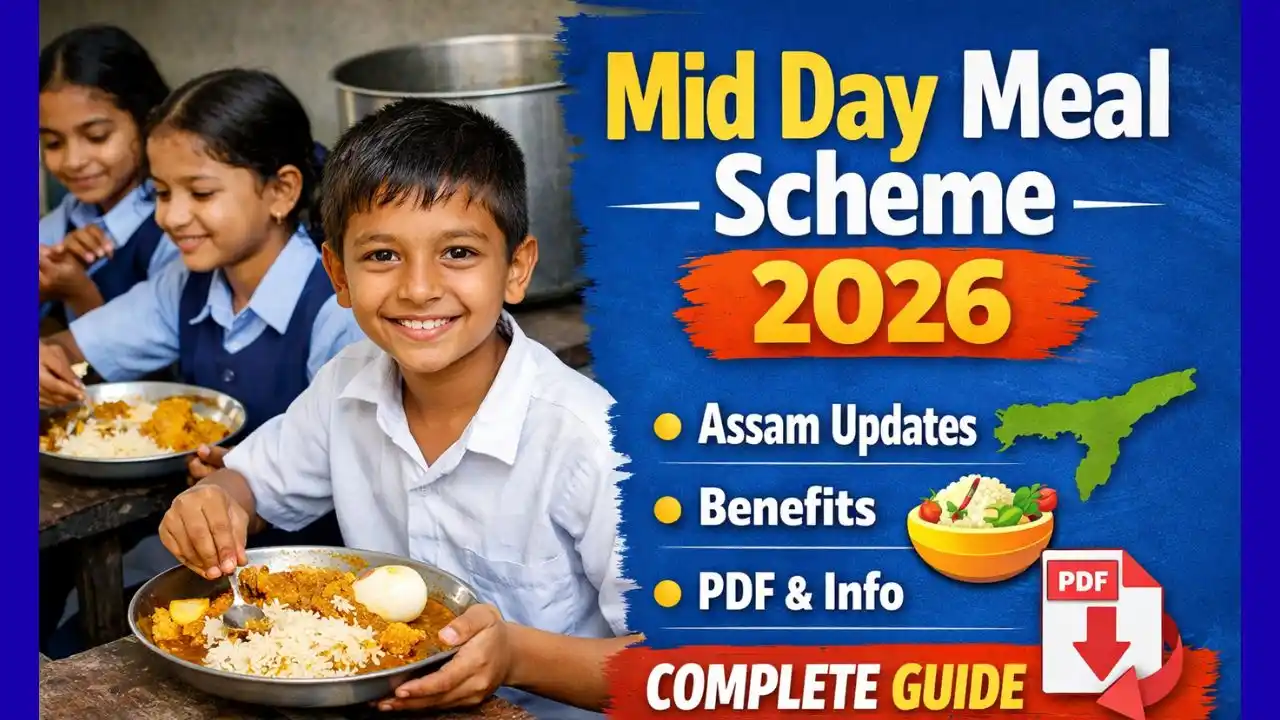
The Mid Day Meal Scheme remains one of India’s most impactful welfare programs, directly connecting nutrition with education. What began as a simple initiative to address classroom hunger has now become a nationwide system supporting millions of children every day. In 2026, the scheme operates under its updated name PM POSHAN (Pradhan Mantri Poshan Shakti Nirman), reflecting a broader vision that goes beyond meals and focuses on overall child development.
Here’s what matters: the scheme is not just about feeding children. It plays a crucial role in improving school attendance, reducing dropout rates, and ensuring better learning outcomes. For many children, especially in rural and economically weaker communities, this meal is the most reliable source of daily nutrition.
In Assam, the program has seen significant improvements in recent years. From better infrastructure to discussions around adding breakfast, the state is actively strengthening its implementation. With updated funding, improved monitoring, and evolving food menus, the Mid Day Meal Scheme in 2026 is more focused, structured, and impactful than ever before.
This guide walks you through everything you need to know, from history and objectives to Assam-specific updates, benefits, and future developments.
What is the Mid Day Meal Scheme?
The Mid Day Meal Scheme is a government-funded program that provides free cooked meals to children studying in government and government-aided schools across India. It covers students from pre-primary (Bal Vatika) up to Class 8.
The idea is simple but powerful: if children receive proper nutrition during school hours, they are more likely to attend regularly, stay focused, and perform better academically.
Initially designed to tackle hunger, the scheme has evolved into a multi-dimensional initiative that addresses:
- Malnutrition among children
- Low school enrollment
- High dropout rates
- Social inequality
Today, it is recognized as the largest school meal program in the world, serving over 100 million children daily.
Meals typically include staple foods like rice, dal, vegetables, and in some regions, eggs or milk. The focus is on providing balanced nutrition while also encouraging healthy eating habits.
Mid Day Meal Scheme Launched in India
The Mid Day Meal Scheme was officially launched in 1995 under the name National Programme of Nutritional Support to Primary Education.
In its early phase, the scheme provided dry rations to children. However, this approach had limited impact. Recognizing the need for improvement, the government introduced cooked meals in 2004, which significantly increased effectiveness.
A major turning point came when the Supreme Court directed all states to implement cooked mid day meals in schools. This transformed the scheme into a universal program across India.
Over the years, several improvements were made:
- Expansion to upper primary classes (Class 6–8)
- Defined nutritional standards
- Better monitoring systems
- Increased funding
- Introduction of safety and hygiene guidelines
In 2021, the scheme was rebranded as PM POSHAN, signaling a broader goal of holistic child development, including health, nutrition, and education.
Mid Day Meal Scheme First State in India
The roots of the Mid Day Meal Scheme go back much earlier than its national launch.
The first structured school meal initiative in India began in the Madras Presidency (present-day Tamil Nadu) in 1920. However, it was in the 1960s that the program gained real momentum under Chief Minister K. Kamaraj.
Tamil Nadu became the first state to implement a large-scale mid day meal program successfully. The results were clear:
- Increased school enrollment
- Improved attendance
- Better child health
This success inspired the central government to adopt the model nationwide in 1995. Even today, Tamil Nadu is often seen as a benchmark for effective implementation of the scheme.
Objectives of Mid Day Meal Scheme
The Mid Day Meal Scheme is built around a set of clearly defined goals. Each objective connects directly to improving both education and child welfare.
Improve Nutritional Status
The primary aim is to provide children with essential calories and protein. Many children in rural and low-income households do not receive adequate nutrition at home. This scheme helps bridge that gap.
Increase School Enrollment
Free meals act as a strong incentive for families to send their children to school, especially in economically weaker sections.
Reduce Dropout Rates
When children receive regular meals at school, they are more likely to attend consistently, reducing dropout rates significantly.
Promote Social Equality
One of the most powerful aspects of the scheme is social integration. Children from different castes, religions, and backgrounds sit together and share the same meal, promoting equality.
Improve Learning Outcomes
Better nutrition directly impacts concentration, memory, and overall academic performance. A well-fed child learns better.
Nutritional Standards Under the Scheme
To ensure consistency and effectiveness, the government has set minimum nutritional standards for meals provided under the scheme.
For primary students (Class 1–5):
- 300 calories
- 8–12 grams of protein
For upper primary students (Class 6–8):
- 700 calories
- 20 grams of protein
Meals are designed to meet these requirements using locally available ingredients. Common food items include:
- Rice or wheat
- Dal (lentils)
- Seasonal vegetables
- Eggs or milk (in some states)
In recent years, there has been a shift toward including millets and more diverse food options to improve nutritional value.
Mid Day Meal Scheme in Assam
The Mid Day Meal Scheme in Assam plays a vital role in improving education and child nutrition, especially in rural and tea garden areas where economic challenges are more pronounced.
The scheme covers:
- Government schools
- Government-aided schools
- Primary and upper primary students
Here’s what stands out in Assam’s implementation:
- Strong focus on increasing school attendance
- Special attention to underserved communities
- Gradual improvement in kitchen infrastructure
- Adoption of national nutrition guidelines
The state government works in coordination with the central government to ensure proper funding and smooth execution.
Efforts are also being made to improve food quality and hygiene through regular inspections and updated safety protocols.
Mid Day Meal Scheme Launched in Assam
Although Assam adopted the scheme as part of the national rollout, its implementation has evolved significantly over the years.
Recent improvements include:
- Expansion to cover more schools and students
- Better cooking facilities in schools
- Introduction of centralized kitchens in selected districts
- Collaboration with NGOs for efficient delivery
Centralized kitchens are a notable development. These facilities prepare meals in bulk under hygienic conditions and distribute them to multiple schools. This ensures consistency in quality and reduces the burden on individual schools.
Latest Update: Mid Day Meal Scheme 2026
The year 2026 brings several important updates that show how the scheme is evolving.
Inclusion of Breakfast in Assam
One of the biggest developments is the proposal to introduce breakfast along with mid day meals.
- Expected to benefit around 35 lakh students
- Aims to improve overall nutrition
- Helps children start their school day with energy
This move reflects a shift toward comprehensive nutrition rather than just a single meal.
Increased Cooking Cost
The government has revised cooking costs to match rising food prices:
- Primary students: around ₹6.78 per child per day
- Upper primary students: around ₹10.17 per child per day
This ensures better meal quality and adequate portion sizes.
Healthier Menus
States are updating meal plans to include:
- Millets
- Pulses
- Green vegetables
The focus is on balanced diets with reduced oil and improved nutritional value.
Better Monitoring Systems
Technology is being used to track meal distribution, attendance, and food quality. This increases transparency and accountability.
Role of NGOs in Mid Day Meal Scheme
Non-governmental organizations play a key role in strengthening the scheme.
Organizations like the Akshaya Patra Foundation have set high standards in food preparation and distribution.
Their contributions include:
- Large-scale centralized kitchens
- High hygiene standards
- Efficient logistics systems
In Assam, partnerships with NGOs are helping improve delivery, especially in urban and semi-urban areas.
Benefits of Mid Day Meal Scheme
The impact of the scheme is visible across multiple areas.
Reduces Hunger
For many children, this meal is their most reliable source of nutrition.
Improves School Attendance
Schools report higher enrollment and consistent attendance after implementation.
Enhances Learning Ability
Proper nutrition leads to better concentration and classroom performance.
Supports Families
It reduces the financial burden on low-income households.
Promotes Equality
Children from different backgrounds eat together, breaking social barriers.
Mid Day Meal Scheme PDF Download
Official documents related to the scheme are available online in PDF format.
These include:
- Detailed guidelines
- Nutritional standards
- Food safety rules
- Implementation procedures
You can access these PDFs through state education department websites or official government portals. They are useful for teachers, administrators, and anyone looking to understand the scheme in detail.
Challenges in Mid Day Meal Scheme
Despite its success, the scheme faces some ongoing challenges.
Food Quality Concerns
Occasional complaints about hygiene and food quality highlight the need for stricter monitoring.
Irregular Supply
In some areas, delays in food supply affect daily distribution.
Infrastructure Gaps
Not all schools have proper kitchens or storage facilities.
Monitoring Issues
Although improving, supervision still needs strengthening in remote areas.
Future of Mid Day Meal Scheme
The scheme is clearly moving toward a more comprehensive approach.
Expected developments include:
- Expansion to include pre-primary children
- Wider adoption of breakfast programs
- Increased use of technology for monitoring
- Better infrastructure and kitchen facilities
- Greater community involvement
The focus is shifting from basic feeding to complete child development, covering nutrition, health, and education together.
Frequently Asked Questions (FAQs) Mid Day Meal Scheme
– What is the Mid Day Meal Scheme 2026?
The Mid Day Meal Scheme 2026, now known as PM POSHAN, is a government program that provides free cooked meals to students from pre-primary to Class 8 in government and aided schools. Its main goal is to improve child nutrition, increase school attendance, and support better learning outcomes.
– Who is eligible for the Mid Day Meal Scheme?
All children studying in government schools, government-aided schools, and some local body schools from Bal Vatika (pre-primary) to Class 8 are eligible to receive meals under the scheme.
– What food is provided under the Mid Day Meal Scheme?
Meals usually include rice, dal, vegetables, and sometimes eggs or milk depending on the state. The menu is designed to meet specific calorie and protein requirements set by the government to ensure proper nutrition.
– What are the latest updates in Mid Day Meal Scheme 2026?
Key updates include increased cooking costs, improved meal quality, inclusion of millets and healthy foods, better monitoring systems, and in some states like Assam, plans to introduce breakfast along with mid day meals.
– How can I download the Mid Day Meal Scheme PDF?
You can download official Mid Day Meal Scheme PDFs from government education department websites or state portals. These documents include detailed guidelines, nutritional standards, and implementation rules for the scheme.
Conclusion
The Mid Day Meal Scheme 2026 continues to stand as one of India’s most effective social programs. It has come a long way from its early days in Tamil Nadu to becoming a nationwide system that supports millions of children every day.
In Assam, the scheme is gaining strength through better planning, improved infrastructure, and innovative steps like the proposed breakfast program. These changes show a clear commitment to improving both nutrition and education outcomes.
Bottom line: this scheme is not just about providing food. It is about giving children a fair chance at a healthier life and better education.
If implemented well, it will continue to shape a stronger, more equal, and better-educated India in the years ahead.
Also read:-
AG is a content writer and researcher at Assam Guwahati, focusing on government schemes, Assam-related updates, education, finance, and public welfare programs. Through assamguwahati.com, he publishes informative articles, guides, and scheme updates to help readers understand benefits, eligibility requirements, and application procedures.