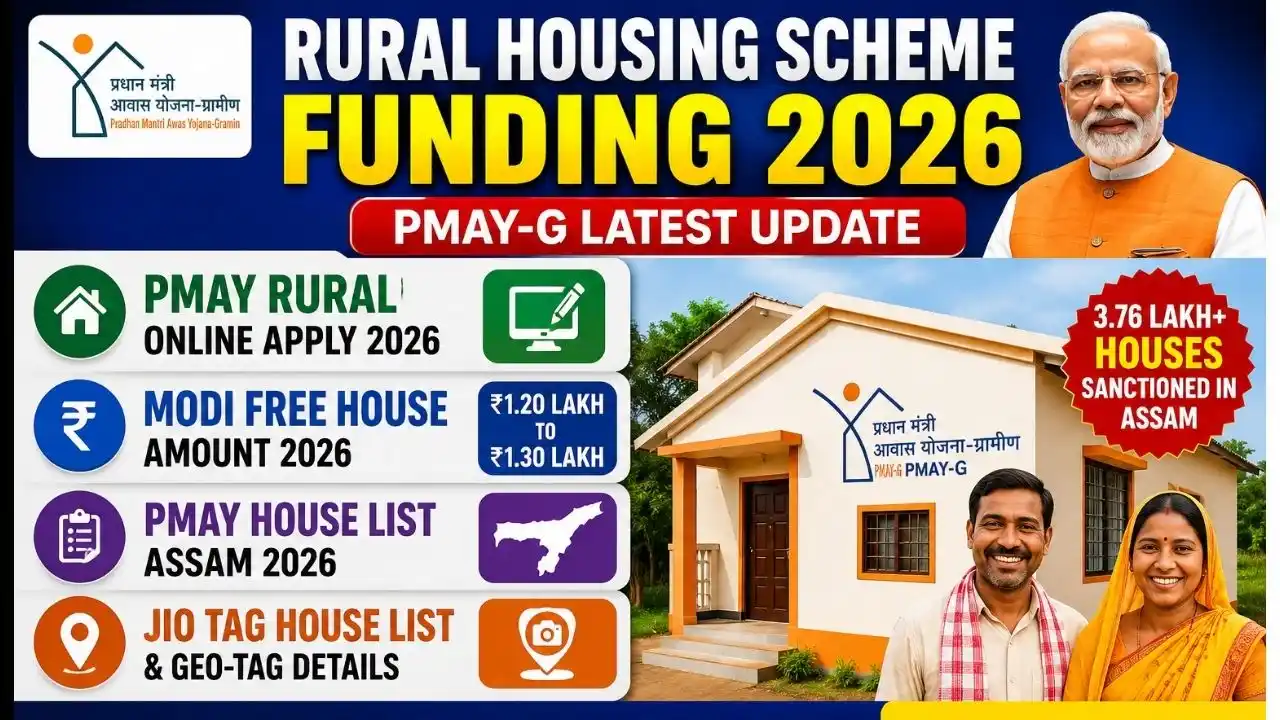
Owning a safe and permanent house remains one of the biggest dreams for millions of rural families across India. To make this dream a reality, the Government of India continues to strengthen the Pradhan Mantri Awas Yojana Gramin (PMAY-G) through increased funding and wider beneficiary coverage. Under the latest Rural Housing Scheme Funding 2026, eligible rural households can receive financial assistance to construct durable pucca houses equipped with basic facilities.
The rural housing initiative has become one of the most successful welfare programs in the country. Since its launch, PMAY-G has helped millions of families move from temporary kutcha houses to permanent homes. According to recent government updates, additional housing targets and funding allocations have been approved for the 2026-27 financial year to accelerate the Housing for All mission.
For residents of Assam, the scheme brings significant opportunities. Thousands of new houses have been sanctioned, and beneficiaries can now check their names in the PMAY House List Assam 2026, monitor construction progress through geo-tagging, and receive financial assistance directly into their bank accounts.
In this comprehensive guide, you will learn everything about Rural Housing Scheme Funding 2026 Assam, PMAY Rural Online Apply 2026, eligibility requirements, housing assistance amount, Assam beneficiary list, geo-tag verification process, and the latest updates related to the Jio Tag House List 2026 Assam.
What is Rural Housing Scheme Funding 2026?
The Rural Housing Scheme Funding 2026 refers to the financial support provided under the Pradhan Mantri Awas Yojana Gramin (PMAY-G) for the construction of permanent houses in rural areas. The primary objective of the scheme is to ensure that every eligible rural family has access to safe and secure housing.
Many families in villages still live in kutcha houses made of mud, bamboo, thatch, or temporary materials. These houses often fail to provide protection during floods, storms, and other natural disasters. Through PMAY-G, the government provides financial assistance that enables poor families to construct durable pucca houses.
The scheme follows a transparent beneficiary selection process based on socio-economic surveys, Gram Sabha verification, and digital monitoring systems. Financial assistance is transferred directly to beneficiaries through Direct Benefit Transfer (DBT), reducing the chances of corruption and delays.
The government has also integrated modern technologies such as Aadhaar authentication, geo-tagging, and online monitoring through AwaasSoft to improve transparency and accountability. These technologies help track construction progress and ensure that funds are used for the intended purpose.
Main Objectives of Rural Housing Scheme Funding 2026
- Provide permanent housing to rural poor families.
- Reduce homelessness in villages.
- Improve living standards and quality of life.
- Promote sanitation and access to basic amenities.
- Ensure transparent distribution of government funds.
- Accelerate the Housing for All mission.
With increased funding and expanded coverage, the Rural Housing Scheme Funding 2026 is expected to benefit lakhs of additional families across India.
Rural Housing Scheme Funding 2026 Assam: Latest Update
Assam has emerged as one of the major beneficiary states under PMAY-G. The state government, in partnership with the central government, continues to expand housing assistance for rural households.
Under the latest approvals, approximately 3.76 lakh additional rural houses have been sanctioned for Assam. This decision is expected to significantly reduce the number of eligible families waiting for housing assistance. The allocation forms part of the broader strategy to improve housing conditions in rural and remote areas of the state.
Beneficiary identification is being carried out through updated survey databases, including Awaas Plus records and local verification processes. Families living in kutcha houses, single-room structures, or without proper shelter are being given priority.
The Assam government has also strengthened digital monitoring systems to ensure that every sanctioned house is properly verified before funds are released. Geo-tagging, Aadhaar verification, and digital payment systems have made the process more transparent than ever before.
Key Highlights for Assam in 2026
- Around 3.76 lakh additional houses approved.
- Priority given to homeless and vulnerable rural families.
- Financial assistance released through DBT.
- Construction monitored through geo-tagging.
- Beneficiary verification through Gram Sabha and surveys.
- Greater transparency through digital tracking systems.
The latest housing approvals are expected to provide significant relief to economically weaker families living in rural Assam.
PMAY Rural Scheme Details 2026
Understanding the PMAY Rural Scheme Details 2026 is essential for anyone seeking housing assistance. PMAY-G was introduced to replace the earlier Indira Awaas Yojana and focuses on providing quality housing support to eligible rural households.
Unlike many welfare schemes, PMAY-G does not rely solely on individual applications. Beneficiaries are primarily identified through official government surveys and local verification processes. This approach helps ensure that assistance reaches genuinely needy families.
The scheme provides financial assistance for constructing a pucca house with basic facilities. Beneficiaries also receive support through convergence with other government programs related to sanitation, employment, and infrastructure development.
Key Features of PMAY-G
- Assistance for construction of pucca houses.
- Direct fund transfer to beneficiaries.
- Digital monitoring through AwaasSoft.
- Aadhaar-based verification.
- Geo-tagging of construction stages.
- Integration with rural development schemes.
- Transparent beneficiary selection process.
Eligibility Criteria
Applicants generally must meet the following conditions:
- Must belong to a rural household.
- Should not own a pucca house.
- Must be included in approved survey data.
- Should be verified by Gram Sabha.
- Must possess valid identification documents.
- Aadhaar-linked bank account is preferred.
Documents Required
- Aadhaar Card
- Voter ID Card
- Ration Card
- Bank Passbook
- Mobile Number
- Residence Certificate
- Income-related details
- Land ownership documents, if applicable
The digital approach adopted under PMAY-G has made beneficiary identification and fund distribution more efficient and transparent.
Modi Free House Scheme Amount 2026
One of the most frequently searched topics is the Modi Free House Scheme Amount 2026. Beneficiaries often want to know how much financial support they can receive under PMAY-G.
The government provides housing assistance based on geographical conditions and construction requirements. The amount is intended to help eligible families build durable houses capable of withstanding local environmental conditions.
PMAY-G Assistance Amount 2026
Plain Areas
Beneficiaries in plain regions generally receive:
₹1.20 lakh
Hilly and Special Category Areas
Beneficiaries residing in difficult terrain and special category regions generally receive:
₹1.30 lakh
In addition to the housing grant, eligible families may also receive support through:
- MGNREGA wage assistance.
- Swachh Bharat Mission toilet assistance.
- Other state-specific benefits.
The financial assistance is usually released in multiple installments. Each installment is linked to a specific construction stage verified through geo-tagging and field inspections.
This structured payment system ensures that houses are completed efficiently while preventing misuse of government funds.
PMAY Rural Online Apply 2026: Application Process
Many rural residents search online for PMAY Rural Online Apply 2026 procedures. However, it is important to understand that PMAY-G follows a beneficiary identification system rather than a completely open online application model.
Most beneficiaries are selected through government surveys such as SECC and Awaas Plus data. Local authorities and Gram Sabhas play a crucial role in verifying eligible households.
How to Get Included Under PMAY-G
Step 1: Participate in Housing Surveys
Ensure your family details are correctly recorded during Awaas Plus or other government surveys.
Step 2: Verify Personal Information
Confirm that Aadhaar, bank account, and household information are accurate.
Step 3: Gram Sabha Verification
Local Gram Sabha members verify the eligibility of applicants.
Step 4: Approval Process
Authorities review survey data and approve eligible beneficiaries.
Step 5: Fund Release
After approval, housing assistance is transferred directly to the beneficiary’s bank account.
Step 6: Construction Monitoring
Construction progress is verified through geo-tagging before subsequent installments are released.
Families should regularly visit their Panchayat office to stay updated regarding beneficiary surveys and approvals.
PMAY House List Assam 2026: How to Check Beneficiary Status
The PMAY House List Assam 2026 allows applicants to verify whether they have been selected under the scheme.
Checking the beneficiary list is important because it provides confirmation regarding approval status and housing assistance eligibility.
Steps to Check PMAY House List Assam 2026
- Visit the PMAY-G official reporting portal.
- Open the AwaasSoft Reports section.
- Select Beneficiary Details for Verification.
- Choose Assam as the state.
- Select district, block, and village.
- Click Search.
- View the beneficiary list.
The beneficiary list contains information regarding approved households and helps maintain transparency throughout the implementation process.
Regular checking of the list is recommended, especially after new survey rounds and beneficiary approvals.
Jio Tag House List 2026 Assam and Geo Tag Verification Process
The Jio Tag House List 2026 Assam is closely linked with the geo-tagging system used under PMAY-G. Geo-tagging has become one of the most important tools for monitoring rural housing construction.
Geo-tagging involves capturing photographs of the house along with GPS coordinates. These images are uploaded to government monitoring systems to verify actual construction progress.
Importance of Geo Tagging
- Prevents fake claims.
- Ensures genuine beneficiaries receive assistance.
- Tracks construction progress accurately.
- Supports transparent fund release.
- Reduces corruption and duplication.
Geo Tagging Stages
Foundation Stage
Photographs are captured when construction begins.
Plinth Stage
The structure is verified after the base and walls are developed.
Roof Stage
Officials verify the roof construction stage.
Completion Stage
Final photographs confirm completion of the house.
After successful verification of each stage, the next installment is released to the beneficiary.
Beneficiaries in Assam can inquire about geo-tagging status through Panchayat offices and PMAY-G monitoring systems.
Benefits of Rural Housing Scheme Funding 2026
The Rural Housing Scheme Funding 2026 offers numerous advantages to rural families and communities.
Better Housing Quality
Families receive assistance to build strong pucca houses that provide greater protection against weather-related damage.
Improved Living Standards
Permanent housing improves comfort, security, and overall quality of life.
Financial Relief
Government assistance significantly reduces the burden of construction costs on low-income families.
Transparent Payment System
Funds are transferred directly into beneficiaries’ bank accounts through DBT.
Digital Monitoring
Advanced technologies ensure accountability and proper utilization of government resources.
Social and Economic Development
Improved housing contributes to better health, education, and economic opportunities in rural areas.
Through these benefits, PMAY-G continues to transform the lives of millions of rural families across India.
Frequently Asked Questions (FAQs) Rural Housing Scheme
– What is Rural Housing Scheme Funding 2026?
Rural Housing Scheme Funding 2026 refers to the financial assistance provided under the Pradhan Mantri Awas Yojana Gramin (PMAY-G) for eligible rural families to construct permanent pucca houses. The scheme aims to provide safe housing to homeless and economically weaker households living in rural areas.
– How can I apply for PMAY Rural Online Apply 2026?
PMAY-G does not have a direct public online application process for most applicants. Beneficiaries are generally identified through SECC data, Awaas Plus surveys, and Gram Sabha verification. If your name is not included, you should contact your local Panchayat office and participate in housing surveys conducted by the government.
– How can I check the PMAY House List Assam 2026?
You can check the PMAY House List Assam 2026 by visiting the official PMAY-G/AwaasSoft portal. Select Assam, choose your district, block, and village, and view the beneficiary list to verify whether your name has been approved for housing assistance.
– What is Jio Tag House List 2026 Assam and why is geo-tagging important?
The Jio Tag House List 2026 Assam is linked to the geo-tagging system used under PMAY-G. Geo-tagging records GPS-based photographs of house construction at different stages. It helps authorities monitor progress, prevents fraudulent claims, ensures transparency, and enables timely release of installment payments to beneficiaries.
Conclusion
The Rural Housing Scheme Funding 2026 remains one of India’s most important rural welfare initiatives. Through the Pradhan Mantri Awas Yojana Gramin (PMAY-G), the government continues to provide financial assistance to eligible families for constructing safe and permanent homes.
With increased funding, additional housing approvals, and advanced digital monitoring systems, the scheme is helping accelerate the goal of Housing for All. Assam has particularly benefited from the latest approvals, with approximately 3.76 lakh additional houses expected to support thousands of rural households.
Families searching for PMAY Rural Online Apply 2026, PMAY House List Assam 2026, Modi Free House Scheme Amount 2026, PMAY Apply Online 2026, and Jio Tag House List 2026 Assam should stay updated through official PMAY-G portals, Gram Sabha meetings, and local Panchayat offices.
As the scheme continues to expand in 2026, it promises to improve housing security, living standards, and economic stability for millions of rural families across India.
Also read:-

AG is a content writer and researcher at Assam Guwahati, focusing on government schemes, Assam-related updates, education, finance, and public welfare programs. Through assamguwahati.com, he publishes informative articles, guides, and scheme updates to help readers understand benefits, eligibility requirements, and application procedures.