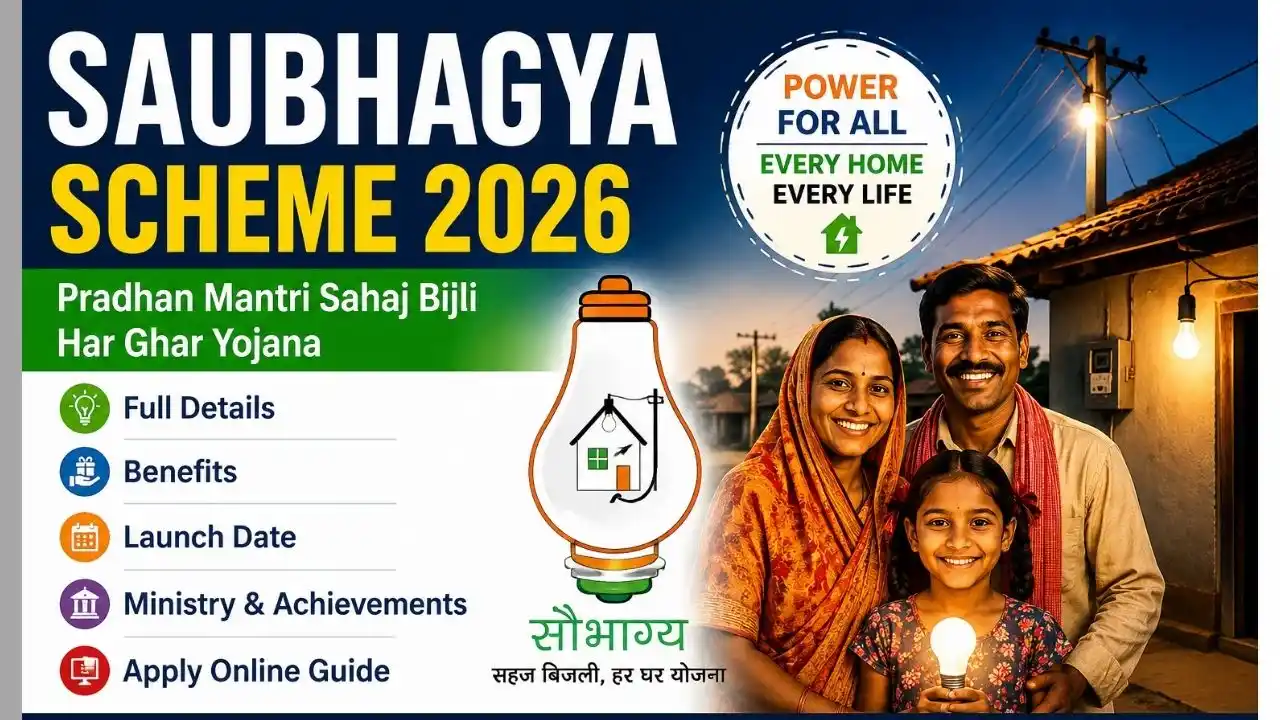
Electricity is one of the most essential basic needs for modern life. From education and healthcare to business and digital services, electricity powers almost every aspect of development. In India, millions of rural and poor households once lived without electricity, especially in remote villages and economically weaker regions. To solve this issue, the Government of India launched the Saubhagya Scheme, officially known as the Pradhan Mantri Sahaj Bijli Har Ghar Yojana.
The scheme became one of India’s largest household electrification missions and transformed rural infrastructure across the country. It aimed to provide electricity connections to all willing households in both rural and urban areas. Under this initiative, crores of families received access to power for the first time.
The scheme not only improved living standards but also supported education, healthcare, employment, women’s safety, and digital connectivity. Even in 2026, the Saubhagya Scheme remains an important topic for students, UPSC aspirants, and people searching for rural electrification benefits in India.
In this detailed article, you will learn everything about the Saubhagya Scheme 2026 including launch date, ministry, objectives, benefits, achievements, Assam implementation, eligibility, application process, UPSC notes, and latest updates.
What is Saubhagya Scheme?
The Saubhagya Scheme is a flagship electrification initiative launched by the Government of India to provide electricity connections to every willing household across the country.
The official name of the scheme is:
Pradhan Mantri Sahaj Bijli Har Ghar Yojana
The main objective of the scheme was to ensure universal household electrification through last-mile connectivity. Before this scheme, many villages were officially electrified, but individual homes still lacked electricity connections. The government identified this gap and introduced Saubhagya to directly connect households to the power network.
The scheme mainly targeted:
- Rural households
- Urban poor families
- Tribal communities
- Remote villages
- Economically weaker sections
Under the scheme, eligible poor families received free electricity connections. In areas where grid connectivity was difficult, the government provided solar power packs and standalone systems.
The Saubhagya Scheme played a major role in improving quality of life. Families gained access to:
- Lighting
- Mobile charging
- Television
- Fans
- Online education
- Digital banking
- Healthcare facilities
The initiative also reduced dependence on kerosene lamps, which were expensive and harmful to health.
According to government data, more than 2.8 crore households were electrified under the program, making it one of the world’s biggest household electrification drives.
Today, the Saubhagya Scheme is considered a landmark welfare and infrastructure program that helped strengthen rural development and energy inclusion in India.
Saubhagya Scheme Details
| Particulars | Details |
|---|---|
| Scheme Name | Saubhagya Scheme |
| Full Form | Pradhan Mantri Sahaj Bijli Har Ghar Yojana |
| Launch Date | 25 September 2017 |
| Launched By | Narendra Modi |
| Ministry | Ministry of Power |
| Nodal Agency | REC Limited |
| Main Objective | Universal household electrification |
| Target Beneficiaries | Rural and urban poor households without electricity |
| Coverage Areas | Rural villages, urban poor areas, tribal and remote regions |
| Major Benefit | Free electricity connections for eligible families |
| Total Outlay | ₹16,320 crore |
| Launch Target | Electricity connection to every willing household |
| Key Focus | Last-mile electricity connectivity |
| Solar Support | Solar power packs for remote areas |
| Major Achievement | 2.8+ crore households electrified |
| Assam Impact | Electrification of remote villages and tea garden areas |
| Important for Exams | UPSC, SSC, Banking, State PSC |
| Official Goal | “Power for All” |
| Current Status | Nationwide household electrification largely completed |
Saubhagya Scheme Full Form
Many people search for the full form of the Saubhagya Scheme.
The full form is:
Pradhan Mantri Sahaj Bijli Har Ghar Yojana
The word “Saubhagya” means prosperity or good fortune. The name reflects the government’s vision of improving living standards and bringing development to every household through electricity access.
The scheme was designed to ensure that no family in India remains without electricity because power availability directly affects economic growth, education, healthcare, communication, and employment opportunities.
The initiative also aligned with the broader national goals of:
- Rural development
- Digital India
- Inclusive growth
- Energy security
- Social welfare
The Saubhagya Scheme became a major milestone in India’s journey toward universal electrification.
Saubhagya Scheme Launch Date
The Saubhagya Scheme launch date was:
25 September 2017
The scheme was launched by Narendra Modi in New Delhi.
The government announced the scheme with the target of achieving universal household electrification by December 2018. The mission was implemented rapidly across states with support from electricity departments, DISCOMs, and local authorities.
The launch date is important for:
- UPSC preparation
- SSC exams
- Banking exams
- State PSC exams
- Government scheme awareness
The launch of the scheme marked a major turning point in India’s rural electrification journey because the focus shifted from only electrifying villages to electrifying individual households.
Saubhagya Scheme Under Which Ministry?
One of the most common questions asked in competitive exams is:
“Saubhagya Scheme comes under which ministry?”
The scheme operates under the:
Ministry of Power
The Ministry of Power was responsible for planning, implementation, monitoring, and coordination of the scheme across India.
The nodal agency for the scheme was:
REC Limited
REC Limited, formerly known as Rural Electrification Corporation, handled implementation support, monitoring, and coordination with states and electricity distribution companies.
The ministry worked closely with:
- State electricity departments
- DISCOMs
- Rural electrification agencies
- Local administration
This strong coordination helped the government complete electrification work in difficult regions within a short period.
Objectives of Saubhagya Scheme
The government launched the Saubhagya Scheme with several major objectives focused on inclusive development and energy access.
1. Universal Household Electrification
The biggest goal of the scheme was to provide electricity connections to every willing household in India.
Earlier, many villages had electricity infrastructure but households remained unconnected. The scheme solved this last-mile connectivity problem.
2. Last-Mile Power Connectivity
The scheme focused on connecting homes directly to electricity lines through proper wiring, meters, and distribution infrastructure.
This ensured actual electricity access at the household level.
3. Rural Development
Electricity is directly linked to development. The scheme aimed to improve:
- Education
- Healthcare
- Employment
- Communication
- Small businesses
Rural electrification also supported economic activities in villages.
4. Reduce Kerosene Usage
Before electrification, many households used kerosene lamps for lighting. These lamps caused pollution, health issues, and financial burden.
The scheme encouraged cleaner and safer electricity-based lighting.
5. Support Digital India
Electricity access enables:
- Mobile charging
- Internet services
- Online education
- Digital banking
- Government e-services
The Saubhagya Scheme helped rural India participate in the digital economy.
Key Features of Saubhagya Scheme
The Saubhagya Scheme included several important features that contributed to its nationwide success.
Free Electricity Connections
Poor households identified through SECC 2011 data received free electricity connections under the scheme.
The government covered the connection cost for eligible beneficiaries.
Coverage of Rural and Urban Areas
The scheme covered:
- Rural households
- Urban poor households
- Remote villages
- Tribal regions
- Difficult terrain areas
This broad coverage ensured nationwide implementation.
Solar Power Support
In inaccessible regions where grid connectivity was difficult, solar photovoltaic systems were provided.
These systems included:
- Solar panels
- Battery banks
- LED lights
- Mobile charging points
This helped remote families access electricity even without traditional power lines.
Financial Outlay
The total outlay of the scheme was around ₹16,320 crore.
The central government provided financial assistance to states for implementation.
Simple Installation Process
Beneficiary households received:
- Electricity meters
- Wiring support
- LED bulbs
- Basic electricity setup
The installation process was simplified through camps and local verification.
Saubhagya Scheme Assam
The Saubhagya Scheme Assam played a significant role in improving electrification across remote and rural regions of Assam.
Assam has several geographical challenges including:
- Flood-prone regions
- River islands
- Forest areas
- Remote villages
- Tribal belts
These conditions made electricity infrastructure development difficult. However, under the Saubhagya Scheme, thousands of households across Assam received electricity connections.
The scheme particularly benefited:
- Tea garden worker communities
- Tribal populations
- Economically weaker families
- Remote village residents
The Assam government worked with central authorities and electricity departments to expand household electrification rapidly.
The impact of the scheme in Assam included:
Better Education
Students gained access to proper lighting, allowing them to study at night.
Improved Healthcare
Health centers and rural clinics received better electricity support for medical equipment and medicine storage.
Growth of Small Businesses
Electricity enabled local businesses such as:
- Tailoring shops
- Grocery stores
- Small manufacturing units
- Mobile repair shops
Digital Connectivity
Families gained access to:
- Internet services
- Television
- Mobile communication
- Online services
Today, electrification in Assam has improved significantly due to the Saubhagya Scheme and related rural development initiatives.
Eligibility Criteria for Saubhagya Scheme
To receive benefits under the scheme, households had to meet specific eligibility conditions.
Eligible Beneficiaries
The scheme mainly targeted:
- Poor rural households
- Urban poor households
- Families without electricity connections
- Households listed in SECC 2011 data
Non-SECC Families
Families not included in SECC data could still receive electricity connections by paying a small amount in installments through electricity bills.
This ensured wider coverage and inclusion.
Required Conditions
Applicants generally needed:
- Identity proof
- Address proof
- Aadhaar card
- Mobile number
- Ration card (if applicable)
The verification process was handled by local electricity officials and DISCOMs.
Benefits of Saubhagya Scheme
The Saubhagya Scheme delivered major social, economic, and developmental benefits across India.
1. Better Education Opportunities
Electric lighting helped students study after sunset. Schools and educational institutions also benefited from improved electricity access.
2. Improved Healthcare Services
Electricity enabled healthcare centers to operate essential medical equipment and store medicines properly.
3. Economic Development
Small businesses and rural enterprises became more productive with electricity access.
Economic activities increased in villages through:
- Cottage industries
- Retail shops
- Agriculture support
- Service businesses
4. Women Empowerment
Women benefited from:
- Safer homes
- Better lighting
- Reduced indoor pollution
- Easier household work
Electricity also improved access to information and communication.
5. Digital Inclusion
The scheme supported Digital India by enabling:
- Mobile charging
- Online learning
- Internet access
- Digital payments
- Government service access
6. Reduced Kerosene Dependency
Families shifted from kerosene lamps to cleaner electricity-based lighting, improving health and reducing expenses.
Saubhagya Scheme Achievements
The achievements of the Saubhagya Scheme are considered historic in India’s infrastructure development journey.
Major Achievements
- More than 2.8 crore households electrified
- Massive rural electrification expansion
- Improved quality of life in remote villages
- Reduced energy poverty
- Enhanced digital connectivity
- Increased social and economic inclusion
Government reports later stated that all states reported 100% household electrification after additional unelectrified households were identified and covered.
The scheme is often described as one of the largest household electrification programs in the world.
The success of the scheme also strengthened India’s global image in infrastructure and rural development.
Saubhagya Scheme UPSC Notes
The Saubhagya Scheme is an important topic for:
- UPSC Prelims
- UPSC Mains
- SSC exams
- Banking exams
- State PSC exams
Important Facts for Exams
| Topic | Details |
|---|---|
| Scheme Name | Pradhan Mantri Sahaj Bijli Har Ghar Yojana |
| Launch Date | 25 September 2017 |
| Ministry | Ministry of Power |
| Objective | Universal household electrification |
| Nodal Agency | REC Limited |
| Total Outlay | ₹16,320 crore |
| Major Achievement | 2.8+ crore households electrified |
Why Important for UPSC?
The scheme relates to several important governance and development topics including:
- Rural development
- Infrastructure growth
- Inclusive development
- Social welfare
- Energy access
- Sustainable development
Questions related to the ministry, objectives, launch date, and achievements are frequently asked in competitive exams.
Saubhagya Scheme Apply Online
Many people still search for:
“Saubhagya Scheme Apply Online”
During the active implementation phase, eligible households could apply through:
- Electricity departments
- DISCOM offices
- Village electrification camps
- Official Saubhagya portal
Documents Required
Applicants generally needed:
- Aadhaar Card
- Address proof
- Identity proof
- Mobile number
- Ration card
Application Process
Step 1: Visit Electricity Office
Applicants visited the nearest electricity department office or electrification camp.
Step 2: Submit Documents
Required documents and household details were submitted for verification.
Step 3: Verification
Officials verified whether the household lacked electricity access.
Step 4: Connection Installation
After approval, electricity meters and wiring were installed.
Step 5: Activation
The household connection was activated for use.
Although the original nationwide target has already been achieved, households still lacking electricity may contact local electricity authorities for assistance.
Challenges Faced During Implementation
Despite major success, the scheme faced several implementation challenges.
Difficult Terrain
Remote hilly areas, forests, and flood-prone regions were difficult to connect.
Infrastructure Gaps
Some villages lacked:
- Transmission lines
- Electric poles
- Transformers
- Distribution systems
DISCOM Financial Burden
Electricity distribution companies faced operational and financial pressure during rapid implementation.
Maintenance Issues
Ensuring continuous and reliable power supply remained difficult in some areas.
However, the government continued strengthening infrastructure and rural electrification systems to improve service quality.
Difference Between Village Electrification and Household Electrification
Before the Saubhagya Scheme, many villages were officially marked as electrified even though households lacked direct connections.
Village Electrification
This means electricity infrastructure exists in the village.
Example:
- Transformer installed
- Electric lines available
- Public buildings connected
Household Electrification
This means individual homes receive electricity connections directly.
The Saubhagya Scheme mainly focused on household electrification rather than only village electrification.
This distinction was very important for improving actual electricity access among families.
Frequently Asked Questions (FAQs) About Saubhagya Scheme
– What is the Saubhagya Scheme?
The Saubhagya Scheme is a Government of India initiative launched to provide electricity connections to all willing households in rural and urban areas. Its official name is Pradhan Mantri Sahaj Bijli Har Ghar Yojana.
– When was the Saubhagya Scheme launched?
The Saubhagya Scheme was launched on 25 September 2017 by Narendra Modi.
– Which ministry is responsible for the Saubhagya Scheme?
The scheme is implemented under the Ministry of Power with support from state electricity departments and DISCOMs.
– What are the main benefits of the Saubhagya Scheme?
The scheme provides electricity access to poor households, improves education and healthcare, supports small businesses, reduces kerosene usage, and increases digital connectivity in rural areas.
– How many households benefited from the Saubhagya Scheme?
According to government reports, more than 2.8 crore households received electricity connections under the Saubhagya Scheme across India.
Conclusion
The Saubhagya Scheme became one of the most successful rural development and infrastructure programs in India. By providing electricity connections to crores of households, the scheme transformed lives across villages, tribal areas, and economically weaker communities.
The program improved education, healthcare, communication, employment opportunities, and digital access for millions of families. It also reduced dependence on kerosene and supported cleaner, safer living conditions.
The Saubhagya Scheme Assam played a particularly important role in connecting remote households and improving electrification in difficult geographical regions.
For students preparing for UPSC, SSC, Banking, and State PSC exams, understanding the Saubhagya Scheme launch date, ministry, objectives, benefits, and achievements remains highly important.
Even in 2026, the scheme stands as a powerful example of India’s commitment to inclusive growth, rural development, and universal electricity access under the vision of “Power for All.”
Also read:-

AG is a content writer and researcher at Assam Guwahati, focusing on government schemes, Assam-related updates, education, finance, and public welfare programs. Through assamguwahati.com, he publishes informative articles, guides, and scheme updates to help readers understand benefits, eligibility requirements, and application procedures.