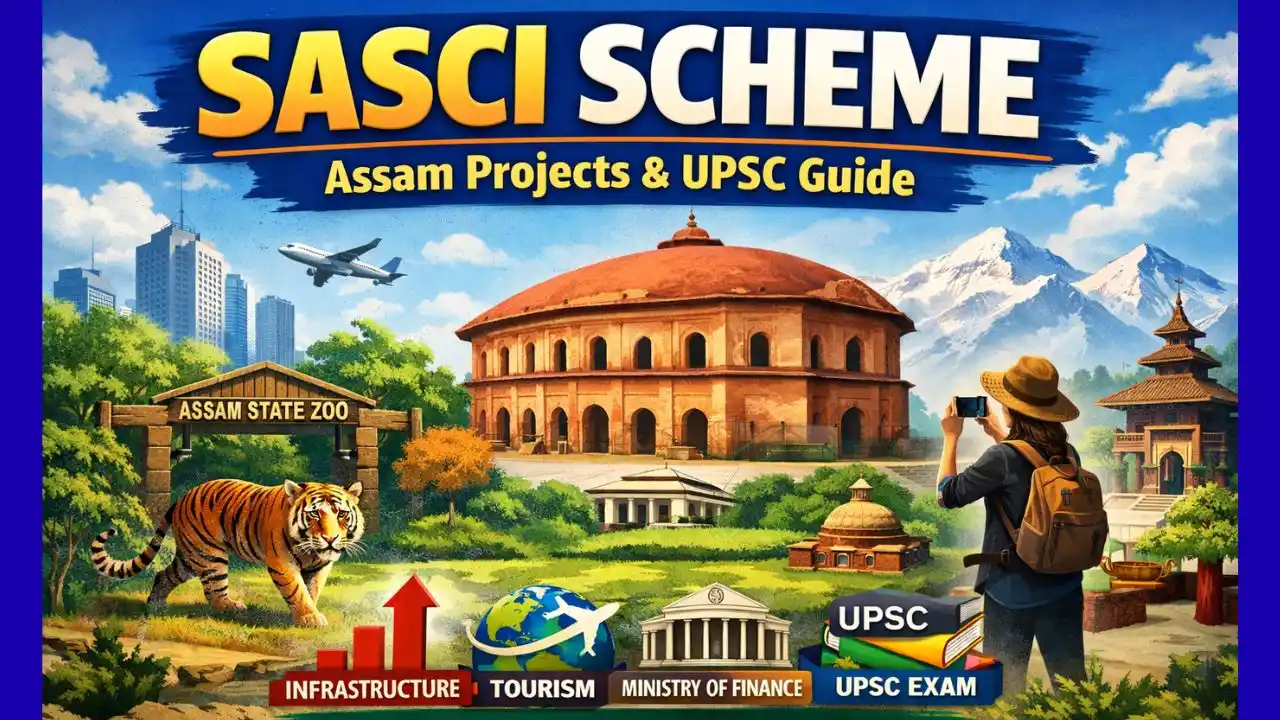
India’s growth story today is closely tied to how effectively it invests in infrastructure and long-term assets. One scheme that plays a major role in this transformation is the SASCI Scheme. Whether you are a student preparing for competitive exams or someone trying to understand government policy, this scheme deserves a closer look.
The SASCI scheme focuses on strengthening states by providing financial support for capital investment. Over time, it has evolved beyond basic infrastructure funding and now includes the development of iconic tourist destinations, especially in regions like Assam and the Northeast.
Here’s what matters. This is not just another funding scheme. It is a strategic move by the central government to push states toward sustainable development, job creation, and global tourism competitiveness.
In this article, you’ll get complete and updated information about the SASCI scheme Assam, including its full form, launch date, ministry, objectives, guidelines, and its importance for UPSC preparation.
SASCI Scheme Full Form
The SASCI scheme full form is:
Special Assistance to States for Capital Investment
The name itself explains the purpose. The scheme is designed to help state governments invest in capital-intensive projects such as roads, tourism infrastructure, public utilities, and urban development.
Let me explain why this matters.
Capital investment is different from regular government spending. Revenue expenditure covers short-term needs like salaries and subsidies. Capital expenditure, on the other hand, creates long-term assets such as highways, airports, tourist facilities, and public infrastructure. These assets continue to generate economic benefits for years.
Under this scheme, the central government provides interest-free loans to states. This is a big advantage because states can take up large projects without worrying about immediate financial pressure.
Another important point is flexibility. States can choose projects based on their own priorities. This means a state like Assam can focus more on tourism and cultural development, while industrial states may focus on logistics and transport infrastructure.
In simple terms, the SASCI scheme is about empowering states to build assets that drive long-term economic growth.
SASCI Scheme: Key Highlights Table
| Feature / Aspect | Details |
|---|---|
| Scheme Name | SASCI (Special Assistance to States for Capital Investment) |
| Launch Year | 2020–21 (during COVID-19 period) |
| Nodal Ministry | Ministry of Finance (Funding) |
| Tourism Ministry | Ministry of Tourism (Tourism Projects) |
| Type of Assistance | 50-year Interest-Free Loans to States |
| Main Objective | Boost capital expenditure and infrastructure development |
| Focus Sectors | Infrastructure, Tourism, Urban Development, Connectivity |
| Special Component | Development of Iconic Tourist Centres to Global Scale |
| Implementation | State Governments |
| Project Timeline | Usually within 2 years |
| Target Beneficiaries | State Governments and indirectly citizens |
| Assam Projects | Assam State Zoo, Rang Ghar Beautification |
| Scheme Validity | Extended till March 31, 2026 |
| Key Benefit | Long-term asset creation and economic growth |
| UPSC Importance | Relevant for Prelims, Mains (GS Paper 3), and Interview |
SASCI Scheme Launch Date
The SASCI scheme launch date goes back to the financial year 2020–21.
This was not a random decision. The scheme was introduced during the COVID-19 pandemic when economic activity had slowed down significantly. States were facing financial stress, and capital expenditure was declining.
To address this, the central government stepped in and launched the scheme to encourage states to continue investing in infrastructure.
Here’s what changed after that.
The scheme didn’t remain limited to pandemic recovery. It gradually expanded and became a permanent tool for boosting capital expenditure across the country.
One major development was the addition of tourism-focused components like:
Development of Iconic Tourist Centres to Global Scale
This shift shows how the scheme has adapted over time. Initially aimed at economic recovery, it is now also focused on enhancing India’s global tourism appeal.
Another important update is that the scheme has been extended multiple times and continues to remain active till March 31, 2026.
So, the launch may have been in response to a crisis, but the scheme has evolved into a long-term development strategy.
SASCI Scheme Under Which Ministry
A common question, especially for exams, is: SASCI scheme under which ministry?
The answer depends on the component you are looking at.
- The tourism-related component is managed by the Ministry of Tourism
- The financial framework is driven by the Ministry of Finance
This dual structure is important to understand.
The Ministry of Finance provides the funding mechanism, including interest-free loans and budget allocation. It ensures that states receive financial support for capital investment.
At the same time, the Ministry of Tourism handles the planning, guidelines, and execution of tourism-related projects under the scheme.
This coordination between ministries ensures that the scheme is both financially strong and strategically focused.
For exam preparation, remember this clearly:
Finance handles funding, Tourism handles implementation (for tourism projects).
Objectives of the SASCI Scheme
The SASCI scheme is not just about giving money to states. It has clear and structured objectives that align with India’s long-term development goals.
1. Boost Capital Expenditure
The primary goal is to increase capital spending by states. This includes building roads, improving urban infrastructure, and developing tourism facilities.
Higher capital expenditure leads to asset creation, which supports economic growth over time.
2. Promote Economic Growth
When large infrastructure projects are launched, they create jobs, increase demand for materials, and stimulate local economies. This creates a multiplier effect across sectors.
3. Develop Tourism Infrastructure
A major focus area is tourism. The scheme supports the development of iconic destinations that can attract both domestic and international tourists.
4. Ensure Sustainable Development
Projects are expected to follow sustainability principles. This includes environmental protection, efficient resource use, and long-term viability.
5. Encourage Regional Balance
The scheme promotes development across all states, with special attention to regions like the Northeast, which have historically been underdeveloped.
Taken together, these objectives make the SASCI scheme a powerful tool for inclusive and balanced growth.
Key Features of the SASCI Scheme
Understanding the features helps you connect the scheme to real-world impact.
Interest-Free Loans
States receive 50-year interest-free loans. This is one of the biggest advantages, as it reduces financial burden significantly.
State-Led Implementation
Projects are executed by state governments. This ensures that local needs and priorities are addressed.
Time-Bound Execution
Most projects must be completed within two years, ensuring faster implementation and results.
Focus on Tourism
Special emphasis is given to developing world-class tourist destinations.
Large-Scale Funding
Thousands of crores have been allocated under the scheme, making it one of the major funding initiatives for infrastructure.
End-to-End Development
The scheme doesn’t just fund construction. It also includes branding, marketing, and promotion of tourist destinations.
Bottom line, the scheme is designed for speed, scale, and impact.
SASCI Scheme Assam: Projects and Impact
The SASCI scheme Assam has played a significant role in boosting tourism and infrastructure in the state.
Key Projects in Assam
Some major projects include:
- Development of Assam State Zoo Cum Botanical Garden, Guwahati
- Beautification and restoration of Rang Ghar in Sivasagar
These projects are aimed at improving visitor experience and preserving cultural heritage.
Economic Impact
Here’s what’s changing on the ground:
- Better tourism infrastructure
- Increased employment opportunities
- Growth in local businesses
- Higher tourist footfall
Tourism has a ripple effect. When a tourist visits, it benefits hotels, transport services, local markets, and artisans.
Focus on Northeast Development
The Northeast, including Assam, has huge untapped tourism potential. Natural beauty, cultural diversity, and historical sites make it ideal for global tourism.
The SASCI scheme is helping unlock this potential by improving infrastructure and visibility.
In simple terms, Assam is becoming a stronger tourism destination because of this scheme.
SASCI Scheme Guidelines (Key Points Explained)
If you go through the official guidelines, a few important aspects stand out.
Project Selection Criteria
Projects are selected based on:
- Connectivity
- Tourism potential
- Economic benefits
- Sustainability
This ensures that only impactful projects receive funding.
Funding Pattern
- Central government provides financial assistance
- States are responsible for execution
This creates accountability at the state level.
Implementation Timeline
Projects must usually be completed within a fixed timeframe, typically two years.
Monitoring System
Regular monitoring ensures transparency and proper use of funds.
Branding and Promotion
The scheme focuses not just on infrastructure but also on marketing destinations globally.
These guidelines ensure that the scheme delivers real and measurable outcomes.
SASCI Scheme UPSC: Why It Is Important
For UPSC aspirants, the SASCI scheme UPSC topic is highly relevant.
Prelims
You should remember:
- Full form
- Launch year
- Ministry involved
- Key features
Mains (GS Paper 3)
The scheme can be linked to:
- Infrastructure development
- Economic growth
- Tourism sector
- Federal cooperation
Interview
Possible discussion areas include:
- Role of capital expenditure in economic growth
- Importance of tourism in India
- Development of Northeast India
This makes SASCI a multi-dimensional topic, useful across all stages of the exam.
Latest Updates on SASCI Scheme (2026)
Here are the latest developments you should know:
- The scheme is active till March 31, 2026
- Continued focus on tourism and infrastructure projects
- Increased funding support to states like Assam and Meghalaya
- Greater emphasis on developing global-level tourist destinations
These updates show that the scheme is still evolving and remains a priority for the government.
Benefits of the SASCI Scheme
For States
- Access to large-scale funding
- Freedom to choose projects
- Reduced financial burden due to interest-free loans
For the Economy
- Job creation
- Increased investment
- Growth in infrastructure
For Citizens
- Better public facilities
- Improved connectivity
- More employment opportunities
For Tourism
- World-class infrastructure
- Increased global visibility
- Growth in tourism revenue
Challenges of the SASCI Scheme
No scheme is without challenges.
Implementation Delays
State-level execution can sometimes slow down progress.
Monitoring Issues
Ensuring transparency across multiple projects can be difficult.
Regional Imbalance
Some states may benefit more depending on project approvals.
Sustainability Concerns
Tourism development must not harm the environment.
Addressing these issues is important for long-term success.
Frequently Asked Questions (FAQs) on SASCI Scheme
– What is the SASCI scheme and its main purpose?
The SASCI scheme (Special Assistance to States for Capital Investment) is a central government initiative aimed at increasing capital expenditure by states. Its main purpose is to support infrastructure development, boost economic growth, and promote sectors like tourism by providing interest-free loans to states for long-term projects.
– When was the SASCI scheme launched?
The SASCI scheme was launched in the financial year 2020–21 during the COVID-19 pandemic. It was introduced to revive the economy by encouraging states to continue investing in infrastructure despite financial constraints.
– Which ministry is responsible for the SASCI scheme?
The financial aspect of the scheme is managed by the Ministry of Finance, while the tourism-related projects are handled by the Ministry of Tourism. This dual structure ensures both funding and proper implementation.
– What are the key benefits of the SASCI scheme for states?
States benefit from 50-year interest-free loans, which allow them to invest in large infrastructure and tourism projects without immediate financial pressure. This leads to better roads, public facilities, job creation, and increased economic activity.
– Why is the SASCI scheme important for UPSC preparation?
The SASCI scheme is important for UPSC because it connects multiple topics like infrastructure development, economic growth, tourism, and cooperative federalism. It is relevant for Prelims (facts), Mains (analysis), and Interviews (discussion-based questions), making it a high-value topic for aspirants.
Conclusion
The SASCI scheme is more than just a funding initiative. It is a long-term strategy aimed at transforming India’s infrastructure and tourism sectors.
From its launch during the COVID-19 crisis to its current focus on global tourism development, the scheme has evolved into a powerful policy tool. By offering interest-free loans to states, it encourages investment in projects that create lasting economic value.
For Assam, the impact is already visible through improved tourism infrastructure and increased opportunities. For students, especially UPSC aspirants, the scheme connects multiple areas like economy, governance, and regional development.
Here’s the bottom line. The SASCI scheme reflects a bigger vision where infrastructure, tourism, and economic growth come together to shape India’s future.
Also read:-

AG is a content writer and researcher at Assam Guwahati, focusing on government schemes, Assam-related updates, education, finance, and public welfare programs. Through assamguwahati.com, he publishes informative articles, guides, and scheme updates to help readers understand benefits, eligibility requirements, and application procedures.